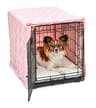
What a crate cover actually does
The AKC’s longer crate-training guide makes a distinction most cover listings skip: some dogs “prefer a wire crate so they can see the world around them, while others settle better in a darker, more den-like crate, such as one with a removable cover.” The cover is for the second dog. If your dog already sleeps through the evening in an open wire crate, a cover is a purchase you can skip.
For the first kind of dog — the one who is up and barking every time someone walks to the kitchen — the cover works by taking away the trigger. It does not calm the dog so much as remove the thing the dog was reacting to. That is why a cover that blocks sight on three sides and leaves the door side open does most of what a full blackout cover does, with a lot more air.
One rule from every source we read, and it is not negotiable: the cover is never dropped over the crate as a punishment. The AKC says it about the crate itself; Diggs, which makes crates and covers, says it specifically about the cover. A dog that learns the cover means “you are in trouble” will not sleep under it.
Ventilation is the spec that matters
VCA’s heat-stroke guidance is written for cars and yards, but the mechanism applies to a covered crate on a warm evening. Panting is a dog’s primary way of regulating body temperature, and panting only works if the air being moved is cooler than the dog. A crate covered on four sides with a heavy waterproof shell is a small tent with a furnace in it. VCA singles out dogs in a poorly ventilated environment as at risk even when the room temperature does not seem high, and flat-faced breeds — pugs, bulldogs, boxers — as at greater risk again because their airway is already restricted.
That gives us four rules, and every pick on this page was chosen against them.
- Never all four sides. Leave the door side open, or at minimum leave the door flap rolled up. Three covered sides is a den; four is a bag.
- Lighter fabric in a heated house. A 100% polyester or poly-cotton cover breathes; a 600D oxford with a PU coating does not, by design. The heavy covers are for porches, garages and travel, and their listings say so.
- Mesh for a warm room or a hot dog. A thick-coated breed, a flat-faced breed, or any dog in a room that runs warm gets the mesh-sided cover, which blocks most of the sight lines and almost none of the air.
- Watch the first covered night. Panting at rest in a covered crate is the cover being too much. Take a side off before you take the cover off entirely.
Fit: the number on the crate, and the door on the crate
Crate covers are sold by the nominal length of a standard wire crate — 24, 30, 36, 42 and 48 inches — and the honest listings publish the finished cover dimensions against each one. The rest say “universal fit.” Two things go wrong with universal.
The crate is not the nominal size.A “42 inch” crate is 42 inches long and roughly 28 wide and 30 high, but brands round differently, and a cover cut for 42 x 28 x 30 will ride two inches short on a crate that is 42 x 30 x 31. MidWest sidesteps the problem by naming the exact iCrate and New World model numbers each cover is cut for, which is the single most useful line on any listing here. Friends Forever publishes the finished cover size for all four of its sizes. Akinerri asks you to allow one to two inches of tolerance, which is at least honest. Measure your crate — the outside of the frame, not the pan — and buy against the finished cover size, not the number in the title.
The door is not where the cover thinks it is. A single-door wire crate opens at one short end. A double-door crate also opens on a long side, and if the cover only lifts at the short end, you will spend every morning holding a flap up with one hand. The covers that handle this properly either roll up on every side (Gorilla Grip, Akinerri) or state single, double and triple door compatibility outright (MidWest). And the cover that fits a top-loading crate is not on this page, because MidWest says plainly that its covers do not accommodate top-door crates and no other listing we resolved claims to.
Fabric, honestly
Cover listings lean on words like heavy-duty, premium and durable, which are adjectives, not specifications. The fabric spec that means something is the denier — 600D, 1200D — which is the weight of the yarn, and any stated coating. Here is what the fabrics on this page are actually for.
| Fabric | What it is good at | The catch |
|---|
| Lightweight polyester | Breathes, washes and dries in a machine, and weighs almost nothing on the crate. The right default indoors | Blocks less light than a heavy cover, and a paw can pull it through the bars |
| Poly-cotton with a stain treatment | Same weight class, softer hand, and MidWest’s Teflon version beads spills for wiping — useful on a puppy crate | Softer is easier to mouth; the prints cost more than plain black |
| Mesh-sided | Continuous airflow with the sight lines mostly broken. The one for a warm room or a hot breed | Not dark. If the dog needs blackout, this is the wrong cover |
| 600D oxford, PU-coated | Shrugs off claws, splashes and being dragged in and out of a car; the only class here where the weight is stated | Waterproof means airtight. Open panels indoors, and skip it for a flat-faced dog |
| “Durable fabric” | Nothing you can check | Three of the seven listings here state no fiber at all. We say so in their cons rather than guessing |
Chew-proof, soundproof, insulated: three words to read past
Chew-proof.MidWest sells its covers as helping to reduce “anxious behaviors like barking and chewing,” and that is a claim about the dog’s state, not the fabric’s. A dog that pulls fabric through the bars from the inside will pull any of these through the bars; the heavy oxford just takes longer to tear. Diggs’ own safety guidance is to store cover panels out of the dog’s reach when they are off the crate, which tells you what the manufacturer expects a chewer to do to them. If your dog is a fabric-eater, the honest answer is a cover that sits proud of the bars — which none of these do — or a crate with solid sides, which is a different page.
Soundproof.A search for a soundproof crate cover returns ordinary polyester covers. No listing we resolved publishes a decibel figure, because a few millimeters of fabric does not have one worth publishing. What a cover changes is what the dog can see, and for the dog that barks at the mail carrier, that is the mechanism that works. If the problem is sound — fireworks, a neighbor’s dog — the cover is not the tool.
Insulated.There are covers sold with a felt lining “for cold winter,” and we resolved one. We did not pick it, for a reason that has nothing to do with the product: a wire crate that needs an insulated cover is a wire crate in a place too cold for the dog. In a heated house the felt is dead weight and one more layer between the dog and the air. If the crate is on a porch or in a garage, the fix is moving the crate, not lining it.
A blanket costs nothing, so when is a cover worth it?
This is a value site, so we will ask the question the category would rather you did not. The AKC mentions the blanket before it mentions the cover, and for finding out whether your dog even likes being covered, a blanket over three sides tonight is the right experiment. If the dog settles, you have your answer for free.
What a fitted cover buys over the blanket is mostly the mornings. A blanket slides off when the dog leans on the side, gets pulled in through the bars by the corner, covers the door when you want it open and the gap when you want it closed, and never quite goes in the wash because it is also the dog’s blanket. A fitted cover stays put, opens over the door, and comes off in one piece for the machine. For a dog crated every night, that is worth the price of the cheapest cover here. For a dog crated twice a month, it is not.
Introducing it
Diggs’ guidance is the sensible version: the top panel first, for a few days, then the sides, then the back, then the door flap last if at all — watching for the signs of stress rather than pushing through them. If the dog is worse with a panel down, take it back up and stay there. Some dogs prefer a partly covered crate permanently, and that is a finished result, not a failure.
Which crate page you actually want
- You do not own the crate yet.Buy the crate first and the cover to match it — see the best wire dog crates, and what size crate your dog needs before either.
- You want the crate to disappear into the room. A cover hides the wire; it does not make the crate a side table. That is crate furniture, and it costs ten times as much.
- The dog chews the cover.Then the dog will chew the pad too, and the pad is the bigger problem — see the best crate pads, which separates chew-resistant from waterproof from comfortable.
- You mainly want it for travel. A soft-sided crate is already a covered crate, with the airflow designed in.
What we would actually buy
For a MidWest iCrate, which is the crate on most of our crate pages, the MidWest cover in the matching size. It is the one listing that names the model numbers it fits, it is light enough to breathe in a heated house, and it survives the dryer. If the crate is the 24-inch puppy size, the Teflon-treated version of the same cover, because puppy crates get wiped down more than they get washed.
If you have an Amazon Basics crate or you are watching every dollar, the Amazon Basics cover in the matching size — accepting that its listing tells you less than MidWest’s does. If the crate opens on two sides, the Gorilla Grip is the cover that opens on all of them. If the room runs warm, or the dog is a Frenchie or a Husky, the mesh-sided Explore Land and nothing heavier.
Only two situations call for the 600D oxford: a crate that lives on a porch or in a garage, or one that rides in a car with the dog. Everywhere else it is more cover than the dog wants. And for a 48-inch crate, the Friends Forever, because it is the one that tells you the finished size before you order.
Whatever you buy, leave the door side open the first week, and never all four sides in summer.