Walk into a pet store and the wall of collars and harnesses is designed to make you think this is a complicated purchase. It is not. A healthy adult dog needs one collar it can wear all day carrying identification, and one harness you clip a leash to for walks. Everything past that — the padded neoprene, the tactical MOLLE panels, the second D-ring you never use, the “training” hardware — is either solving a problem your dog does not have or creating one.
This section is built around that idea, and around the specific way a value buyer shops: the cheapest thing that genuinely does the job wins, and the expensive thing has to explain itself. Minimalist here is not an aesthetic. It is four measurable properties.
What actually makes a collar minimalist
Width. The single biggest driver of how much a collar intrudes. Manufacturers publish it, and the range across the collars we recommend runs from 3/8 in for a toy breed up to 1 in for a large dog. Buy wider than your dog needs and you get a stiff band that parts the coat and catches under the jaw; buy narrower than it needs and you concentrate pressure into a thin line. There is a right answer per size band, and it is published rather than guessed — our size guide lays it out.
No padding. Neoprene lining feels like a kindness in the shop and is genuinely useful for a dog with a skin issue, but it roughly doubles the bulk around the neck, holds water for hours after a wet walk, and makes the collar something the dog is aware of all day. For most dogs the padding is solving a problem the correct width already solved.
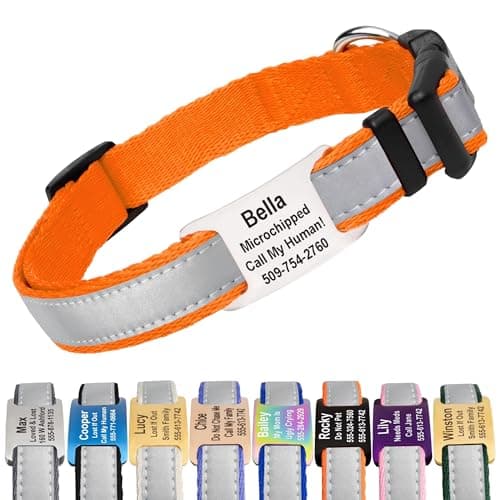
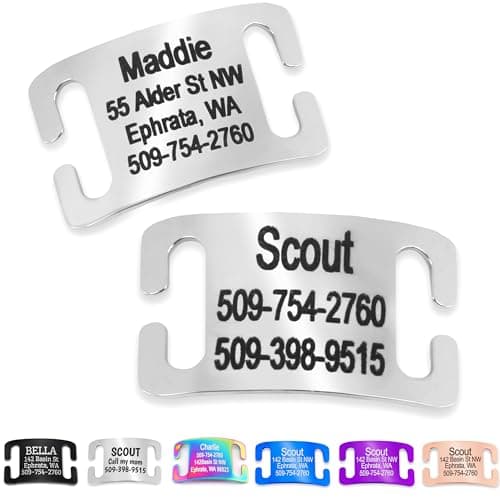
Nothing hanging. A dangling ID tag is the loudest, most snaggable thing on a dog. It also fails in the one situation it exists for: tags come off. Stitched or plated identification puts your phone number on the collar itself, silently — which is why the value pick at the top of this page is a personalized collar rather than a plain one, and why we’ve given the three ways to go tagless their own page.
A material that suits your week. Nylon is cheap, dries slowly and eventually smells. Leather is comfortable and looks better with age, but the listings for the rolled leather collars we like say dry clean only, which rules them out for a dog that swims. Coated webbing — BioThane and its equivalents — absorbs nothing at all, and its manufacturer is refreshingly clear that the coating is a jacket over polyester webbing rather than the strength itself. That three-way choice is most of the buying decision, so it gets its own comparison.
And the harness: one, fitted properly
The other half of a minimal kit is the harness, and here minimalism means something slightly different: buying one harness that works instead of a drawer full of things that did not. The mechanism that reduces pulling is narrow and specific — a leash ring on the front of the chest, or a chest strap that tightens slightly when the dog leans into it. Everything else marketed as “no-pull” is a back-clip vest with the words printed on the box.
Two harnesses cover almost everyone. A dual-clip vest gives you a front ring for the training phase and a back ring for the years afterwards, at a price that makes the decision easy. A minimal-coverage front-clip harness — the kind whose own listing describes it as having less coverage than other harnesses, and therefore lighter and more breathable — is the answer for a dog that overheats or objects to a full vest. Both are below. What neither will do is train your dog, and the American Kennel Club is consistent on that point: the harness makes pulling less rewarding and buys you control while you do the actual work. How each mechanism works and what to check when it isn’t working are the two pages most people need next.
One last thing, because it is the whole reason this section exists: the expensive option is frequently not the better one. The clearest example on this site is a well-known house-brand harness that publishes exactly the same feature list as a harness costing a fraction of the price. We reviewed it and put the two side by side, and the conclusion is the one this whole section is built on: read the spec list, not the shelf.