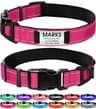
Two complaints send people looking for a tagless collar, and they are the same complaint viewed from different ends. One is noise: a metal tag against a metal D-ring is a bell your dog wears every waking hour, and once you have noticed it in the kitchen at six in the morning you cannot un-notice it. The other is minimalism: a dangling tag is the single bulkiest, snaggiest thing on an otherwise clean collar.
There is a third reason that matters more than either, and it is the one the American Kennel Club raises: hanging tags come off. They unclip, the split ring works open, the engraving wears smooth. A tag that is in a hedge two miles back is not identifying anybody. Putting the identification onto the collar itself fixes the noise, the bulk and the reliability in one purchase.
Three approaches do it, and they are ranked below cheapest first, because the cheapest one is genuinely the right answer for most people: a flat plate that slides onto the collar you already own. Only if you also want a new collar do the other two become relevant — and then the choice is between stitching the number into the webbing, which is the most minimal option there is, and a fixed steel plate, which stays readable for far longer.
Which of the three should you buy?
- Your collar is fine and only the noise bothers you: buy the slide-on plate. Check two things on your existing collar — its width, and whether it has a snap buckle or a belt-style buckle — because the plate is sized to width and comes in an open design for snap closures and a solid one for belt buckles.
- You want the absolute flattest collar possible: embroidery. The name and number are stitched into the webbing, so there is no plate, no ring, and nothing raised at all. It is the only genuinely tagless option in the strict sense.
- You want ID that is still readable in five years: a fixed steel nameplate. Laser-etched steel outlasts thread, and it is easier to read at arm’s length by a stranger holding a dog they have just found — which is the actual use case.
- You want reflectivity too: all three of the collars here publish reflective stitching or webbing. It is close to standard now, and worth having on a dark morning.
What to put on it
You get up to four lines on most of these. The AKC’s guidance on tags is that the contact details are the point, so spend the lines accordingly:
- Your phone number — the single most important line, and the one people leave off in favor of the dog’s name. A stranger does not need to know the dog’s name to call you.
- A second number if you have the room. One unanswered phone should not end the search.
- The dog’s name — useful for calming a found dog, and nice to have, but third in the queue.
- “Microchipped” if the dog is. It tells whoever finds it that a vet or shelter can identify the dog even if the collar comes off.
Tagless is not a substitute for a microchip
Worth being clear about, because the two get conflated. A collar — tagless or otherwise — is the fast route home: the person who finds your dog can phone you from where they are standing. A microchip is the backup for when the collar is gone, and the AKC is explicit that a chip carries only an ID number, that it must be registered to be useful, and that it is not a tracker. Do both. Put the number on the collar, and keep the chip registration up to date.
The one downside of every option here
Personalization is permanent, and personalized items generally cannot be returned — the listings say so plainly. That has two consequences. If you change your phone number, you are buying a new plate or a new collar. And if you are unsure about sizing, take the neck measurement twice before you order, because a personalized collar in the wrong size is not going back. Our published size chart lists the width and neck range for every collar here.