Collar Creek

The best dog gate

A gate is the cheapest training aid in the house — it removes the opportunity instead of correcting the behavior. Getting the mount type right is the only hard part.

By Stephen V.Updated How we research

Gates do something no amount of training does quickly: they make the problem impossible. A puppy that cannot get to the stairs does not need to be taught to stay off them, and a dog that cannot reach the front door cannot rehearse charging at the postman.

AKC guidance on dog gates splits the category three ways — pressure-mounted, hardware-mounted, and freestanding — and that split is the whole buying decision. Pressure gates hold by friction against the frame; hardware gates bolt to the wall; freestanding gates simply stand there and work on dogs that respect a barrier.

The other number that matters is height. AKC’s figures are that around 20 inches suits puppies and small breeds, and that bigger breeds or jumpers need at least 30 inches. Our overall pick is the Carlson, because the built-in cat door solves the problem every multi-pet household hits.

How this is funded: we earn a commission if you buy through our links, at no extra cost to you. It never changes which product we recommend, and we’ll tell you when we’d skip one. Full disclosure.

Quick picks

Ranked on specs, value and fit. Select a row to jump to the full write-up. We have not tested these ourselves — here is exactly what we do instead.

#ProductBest forPrice
1
Carlson Pet Products Extra Wide Walk-Through Gate with Pet Door

Carlson Pet Products Extra Wide Walk-Through Gate with Pet Door

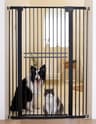
The gate with the small pet door built in, which is the feature that makes a gate liveable: the cat keeps its run of the house while the dog stays put. A 16.5 in walk-through opening and a one-touch latch on top of that.

Best overall
$44.99 · View on Amazon

Price as of September 15, 2026. #ad How we’re funded

2
cideny Auto-Close Gate, 29-40 in

cideny Auto-Close Gate, 29-40 in

The value auto-close gate, and the anti-stumble pedal is the detail worth noting: the bottom bar sits low and ramped instead of standing proud, so you stop catching your foot on it twenty times a day.

Best value
$49.99 · View on Amazon

Price as of September 15, 2026. #ad How we’re funded

3
keny Extra Wide Pressure-Mounted Gate, 29-55 in

keny Extra Wide Pressure-Mounted Gate, 29-55 in

For the opening the normal gates do not reach — hallways, wide doorways, the gap between a kitchen island and a wall. Fifty-five inches on a pressure mount, all-steel, with an auto-close door and a one-handed release.

Best for wide openings
$69.99 · View on Amazon

Price as of September 15, 2026. #ad How we’re funded

4
No Pawblems Extra Tall Pet Gate, 55 in

No Pawblems Extra Tall Pet Gate, 55 in

Fifty-five inches tall, which is the honest answer for a dog that clears a standard gate — you do not train a jumper out of jumping with a taller gate, but you do stop it. Bar spacing of 1.37 in also stops a small dog slipping through.

Best for jumpers
$129.99 · View on Amazon

$162.4920% off

Price as of September 15, 2026. #ad How we’re funded

The picks in full

#1Best overall

Carlson Pet Products Extra Wide Walk-Through Gate with Pet Door

The gate with the small pet door built in, which is the feature that makes a gate liveable: the cat keeps its run of the house while the dog stays put. A 16.5 in walk-through opening and a one-touch latch on top of that.

Strengths

  • Built-in small pet door lets cats through and keeps the dog in
  • 16.5 in walk-through door with a one-touch latch
  • Pressure mounted — no drilling, so it suits rentals

Trade-offs

  • 30 in tall: a determined jumper clears it
  • Fits 29.5-36.5 in only, and needs the extension above 32 in
Fits openings29.5-36.5 in
Height30 in
Walk-through door16.5 in
Pet doorYes — small pet / cat

Specs read from the product listing on August 22, 2026. “Not published” means the brand does not state that figure.

#2Best value

cideny Auto-Close Gate, 29-40 in

The value auto-close gate, and the anti-stumble pedal is the detail worth noting: the bottom bar sits low and ramped instead of standing proud, so you stop catching your foot on it twenty times a day.

Strengths

  • Auto-close and a dual-lock latch at the lower price point
  • Anti-stumble ramped bottom bar rather than a raised rail
  • Tool-free pressure mount that does not mark walls

Trade-offs

  • 29-40 in range only
  • Like all pressure gates, not for the top of a staircase
Fits openings29-40 in
MountPressure, tool-free
DoorAuto-close, dual lock
ExtraAnti-stumble bottom bar

Specs read from the product listing on August 22, 2026. “Not published” means the brand does not state that figure.

#3Best for wide openings

keny Extra Wide Pressure-Mounted Gate, 29-55 in

For the opening the normal gates do not reach — hallways, wide doorways, the gap between a kitchen island and a wall. Fifty-five inches on a pressure mount, all-steel, with an auto-close door and a one-handed release.

Strengths

  • Spans up to 55 in without drilling
  • Auto-close under 90 degrees, so it shuts if you forget
  • All-steel construction rather than steel-and-plastic

Trade-offs

  • A pressure mount at full width is inherently less rigid
  • Pressure gates should never be used at the top of stairs
Fits openings29-55 in
MountPressure, no drilling
DoorAuto-close, one-handed release
ConstructionAll steel

Specs read from the product listing on August 22, 2026. “Not published” means the brand does not state that figure.

#4Best for jumpers

No Pawblems Extra Tall Pet Gate, 55 in

Fifty-five inches tall, which is the honest answer for a dog that clears a standard gate — you do not train a jumper out of jumping with a taller gate, but you do stop it. Bar spacing of 1.37 in also stops a small dog slipping through.

Strengths

  • 55 in height defeats jumping that a 30 in gate invites
  • 1.37 in bar spacing stops small dogs squeezing through
  • Auto-close with a hold-open position past 90 degrees

Trade-offs

  • Three times the price of a standard-height gate
  • It is a visually dominant object in a doorway
Height55 in
Fits openings29-40 in
Bar spacing1.37 in
DoorAuto-close with hold-open

Specs read from the product listing on August 22, 2026. “Not published” means the brand does not state that figure.

Mount type: the one decision that matters

Pressure-mountedHardware-mountedFreestanding
FixingFriction against the frameBolted to wall or frameNone
Top of stairsNeverYes — the only safe optionNo
Wall damageMarks, no holesHolesNone
SuitsDoorways, rentals, most dogsStairs, large or determined dogsCalm dogs, temporary use

The one line to take from that table: a pressure-mounted gate must never go at the top of a staircase. AKC guidance is explicit that hardware-mounted gates are the more secure option and the right choice for the top of stairs, because a pressure gate that is leaned on hard enough gives way — and gives way in the direction of the drop.

At the bottom of stairs, in doorways, and across hallways, a pressure gate is fine and is what most households should buy.

Height, by dog

AKC’s guidance is around 20 inches for puppies and small breeds, and at least 30 inches for bigger dogs or jumpers. Most of the market clusters at 30 inches, which covers the majority of households.

Above that there is a specialist tier at 51 to 55 inches for dogs that genuinely clear a normal gate. It costs two to three times as much and it is visually dominant in a doorway, but for a dog that has learned it can jump a 30-inch gate, a taller one is the only thing that works — a jumper does not un-learn.

Bar spacing, if there is a small animal in the house

A gate that stops a labrador and lets a cat through is doing exactly its job. A gate that stops a labrador and lets a chihuahua through is not.

Check the stated spacing where it matters: the No Pawblems tall gate specifies 1.37 in, which is tight enough to stop a small dog squeezing through and, importantly, to stop one getting a head stuck. That is the real risk with wide spacing, and it is worth two minutes of checking.

The cat-door feature is genuinely useful

The classic multi-pet problem: the cat needs its litter tray, its food and its escape route, and the dog needs to be nowhere near any of them. A gate with a small pet door built in solves all three at once.

That is why the Carlson is our overall pick despite being an old design. The alternative — a gate propped at cat height, or a gate that gets opened forty times a day — is worse.

Auto-close is not a luxury

A gate only works when it is shut, and a manually latched gate in a busy household is open a meaningful fraction of the time. An auto-close mechanism swings the door shut whenever it is released under about 90 degrees, which removes the human error entirely.

Most also have a hold-open position past 90 degrees for when you are carrying laundry through. Both features are now standard at the $45 mark, so there is little reason to buy a gate without them.

The bottom bar you keep tripping on

Walk-through pressure gates need a bottom rail to hold their tension, and that rail sits at exactly ankle height. Most people who dislike their dog gate dislike it because of that bar.

The fix exists: several gates now use a low ramped anti-stumble bar rather than a raised rail. The Cideny specifies one, and it is a genuine daily quality-of-life difference over years of ownership.

Measuring, and the extension trap

Measure the opening at the height the gate will sit, not at the floor — skirting boards and out-of-square door frames mean the two numbers differ.

Then check the fitted ranges rather than the headline number. Gates that ship with extension panels often have gaps in their coverage: the Keny 42.5 in gate, for example, does not fit openings between 31.8 and 33.4 in or between 38.7 and 40.3 in, because those fall between one extension and the next. That is normal for the category and it is written in the listing — read it before ordering.

Where gates earn their money

  • House training.Confining a puppy to one hard-floored, puppy-proofed room is the standard first step, and gates are how you do it. The AKC’s puppy-proofing guidance builds on exactly this.
  • The front door. A gate one room back stops door-charging becoming a habit and gives you a buffer when a delivery arrives.
  • The kitchen. Hot pans, dropped food and cleaning products; a gate is simpler than supervision.
  • Separating dogs.A new dog, a recovering dog, or two that need a break from each other — a gate keeps them in sight without contact.
  • Stairs, for a senior dog. Often more useful than a ramp, since it removes the descent entirely. See our ramps and steps guide.

Frequently asked questions

Can I use a pressure-mounted gate at the top of the stairs?

No. A pressure gate holds by friction and gives way if leaned on hard enough — and it gives way in the direction of the drop. AKC guidance is that hardware-mounted gates, bolted to the wall or frame, are the secure option and the right choice for the top of a staircase.

How tall should a dog gate be?

AKC guidance puts around 20 inches as workable for puppies and small breeds, and at least 30 inches for bigger dogs or jumpers. Most gates are 30 inches. If your dog has already learned it can clear that, the 51 to 55 inch tier is the only thing that works — jumpers do not un-learn.

What is the difference between a pressure-mounted and a hardware-mounted dog gate?

A pressure gate holds itself in place by pushing against the door frame, so it needs no drilling and suits rentals and doorways. A hardware-mounted gate bolts into the wall or frame and is far more secure, which is why it is the only sensible option at the top of stairs or for a large determined dog.

Do dog gates need an auto-close mechanism?

It is worth having. A gate only works when it is shut, and a manually latched gate in a busy household is open a meaningful share of the time. Auto-close swings the door shut whenever it is released under about 90 degrees, and it is standard at around the $45 mark.

How do I measure for a dog gate?

Measure the opening at the height the gate will sit rather than at the floor, since skirting boards and out-of-square frames change the number. Then read the fitted ranges rather than the headline width — gates with extension panels often have gaps in coverage between one extension and the next.

Sources

Keep reading