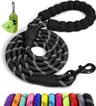
The four specs that decide whether a leash is any good
Rank leashes on these, in this order, and the field sorts itself out fast. Brand is not on the list.
- The handle. This is the part you hold, and the part the cheapest leashes get wrong. A folded loop of flat nylon is fine until a dog lunges, at which point it becomes a cheese wire. A padded rope handle or a neoprene sleeve costs pennies more and is the difference between a walk you enjoy and a walk you endure.
- The snap. The clip is the only component whose failure loses you the dog, and it is where a bargain leash saves money. A solid bolt or trigger snap in cast metal is what you want; a thin stamped-alloy swivel on a big dog is a gamble. Weight of hardware should match weight of dog — heavier is not better on a 10 lb terrier, where a chunky clip drags the collar sideways.
- The length. The AKC’s own leash guidance puts four to six feet as the everyday standard, and that is not a compromise — it is the distance at which you can actually influence a dog. Shorter than four feet is a traffic tool. Longer than eight feet belongs on a long line in open space, not on a sidewalk.
- Reflectivity. Reflective thread woven into the webbing costs a manufacturer close to nothing and is the single cheapest safety upgrade available to anyone who walks before sunrise or after sunset. There is no good reason to buy a walking leash without it, and six of the eight picks here publish it — the two that do not are the long line and the small-dog leash, where the listing states no reflective trim.
Material matters less than people think, but it is not nothing. Braided rope is soft in the hand and stretches a fraction under load, which takes the sting out of a sudden pull. Flat nylon is lighter, dries faster and packs smaller. Coated webbing — the PVC-sheathed kind used on the long line here — exists for one reason: it does not soak up a wet field.
Which type of leash do you actually need?
Read this table before you read the picks. It is the decision that matters; the pick inside each row is the easy part.
| Type | What it is for | What it is bad at |
|---|
| Rope, 4–6 ft | The default everyday walk. Cushioned grip, absorbs a lunge, cheap. | Giant breeds, where the snap rather than the rope is the weak point. |
| Flat nylon, 4–6 ft | Light, washable, dries fast. Good second leash for the car or a bag. | Hand comfort under load, unless the handle is padded. |
| Double-handle (traffic) | Large, strong dogs in busy places — choke up to a foot of leash without wrapping it round your fist. | Small dogs and quiet streets. It is bulk you are carrying for nothing. |
| Hands-free bungee | Running and hiking. The stretch stops a mid-stride pull from jolting your spine. | Loose-leash training. Constant light tension is the opposite of the lesson. |
| Long line, 15–50 ft | Recall practice and sniffing freedom in open space, with the dog still attached. | Anywhere with people, bicycles or traffic. It is a training tool, not a walking leash. |
| Retractable | Open, empty space with a dog that does not pull and an owner who locks it short near roads. | Training, control and your own hands. The AKC is explicit about the risks. |
Why the long line ranks above the retractable
Both promise the same thing — let the dog go further — and only one of them does it without a mechanism in the middle. A long line is webbing and a snap: nothing to jam, nothing to drop, nothing that keeps a constant half-pound of tension on the collar. A retractable keeps the line under spring tension by design, which the AKC notes teaches a dog that pulling is what extends the leash — precisely the lesson you spend months undoing with loose-leash training. The AKC’s own safe-use advice for retractables is to treat them as open-space equipment and to keep a fixed 6 ft leash for everything else.
That is the whole reason a retractable sits last on this list rather than off it. Plenty of people want one, some uses are legitimate, and the pick here is the one that publishes real weight bands instead of hiding behind S/M/L sizing. If that is the route you want, the full set is on the retractable leash page, and the honest alternative is on the long line page.
What a dog leash should cost
Qualitatively, here is the shape of the market, all of it confirmed against the live prices on this page (November 22, 2026).
- Low single digits. A plain rope or nylon leash with a padded handle. Genuinely fine. This is the price floor and the Taglory pick sits on it.
- Low double digits. The sweet spot: better snaps, a traffic handle, reflective stitching throughout, published dimensions. Six of the eight picks here live in this band, and so does the overall winner.
- High double digits. You are buying a specific mechanism now — a bungee section, a waist belt, a long tape on a spring — not better leash. Worth it if you run with your dog. Not worth it for a sidewalk walk.
- Three figures. Leather, hand-stitching, boutique hardware. A nice object. It will not control your dog any better than the rope leash at the top of this page, and we will not pretend otherwise.
The pattern is the same one we find across this site: the curve flattens almost immediately and then you are paying for materials and brand. Our leash buying guide walks the specs in more depth, and the same exercise for the other half of the walking kit is on the everyday collar roundup.
The leash is not your pull-control tool
Worth saying plainly, because it is the most expensive mistake in this category: if your dog leans into the leash, no leash fixes it. The AKC’s guidance on pulling is about technique and about where the leash attaches — a front-clip harness moves the force off the neck and gives you steering, which a leash cannot do at any price. A double-handle leash makes a strong dog manageable in traffic; it does not teach anything.
So buy the leash for the walk and, if your dog pulls, add a harness rather than a fancier leash. We keep the cheap end of that honest on the best dog harness under $50, and the technique itself is on how to stop leash pulling.
What we would actually buy
One dog, normal walks, no drama: the BAAPET rope leash in 6 ft. It is the best value in the category and there is very little reason to spend more.
A big dog on busy streets: the Primal double-handle. The second handle 12 inches above the clip is the feature you will use every single walk.
A small dog: the Voyager 5 ft nylon leash. A padded neoprene handle on a small-dog leash is rarer than it should be, and the lighter hardware does not drag the collar sideways.
A leash to leave in the car: the Taglory rope leash. Cheap enough to own three and still reflective.
Running or hiking: the Ruffwear Roamer. It is the one premium pick here and it earns it on the bungee section alone.
Recall practice: the NIMBLE long lead in 30 ft, because a coated line does not come home as a wet rope that smells of field.
A rescue or a reactive dog:none of these on their own — read the reactive-dog leash picks first, because handle redundancy and length matter more than material there.
Replacing a retractable you already own: read the Flexi leash alternatives rather than this page. The ranking there is built on the four jobs a retractable does simultaneously — distance, slack management, a brake and give — which is a different question from which leash type suits your walk, and it produces a different answer.