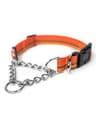
The AKC describes a martingale plainly: two loops, one that sits round the dog’s neck and a smaller control loop that tightens it when the dog pulls, without obstructing the airway the way a choke chain does. That limited travel is the whole design — it closes far enough that the collar can no longer slide over the head, and then it stops.
The dogs that need one are the ones the AKC names: dogs whose necks are about the same width as their heads. Greyhounds and the other sighthounds are the obvious case, but plenty of ordinary rescues, whippety crosses and slim-headed dogs will back out of a flat collar the first time something frightens them. If you have ever watched a dog reverse out of its collar in a car park, you already know why this category exists.
The buying decision has two axes: nylon or chain for the control loop, and quick-release buckle or slip-over for getting it on. Our value pick, the Joytale, is all-nylon with a quick-release buckle, reflective stitching and a rustproof D-ring, and it costs less than a bag of good treats. Its honest limitation is that an all-nylon cinch gives a softer, vaguer cue than a chain, and a buckle is one more component that can fail than a plain slip-over loop.
Nylon or chain?
Both do the same job; they feel different to the dog and they behave differently over time.
- All-nylon is silent, lighter, softer against the coat and cheaper. The cinch is gentler and slightly less precise. It is the right default for a dog that mainly needs escape prevention rather than a training cue.
- Chain control loop gives a crisper, more immediate cue and the metal does not stretch or fray with use. It jangles, which genuinely bothers some dogs and some owners, and it can mark a long coat over time. Mighty Paw and Ruffwear both use stainless chain, which is the version worth having — plated chain discolours.
One important thing neither type is: a choke chain. A martingale’s travel is limited by the length of the control loop, so correctly sized it physically cannot close beyond the dog’s neck circumference. A choke chain has no such limit. They are not the same tool and should not be treated as if they were.
Fitting one properly — the part that matters
A martingale is the collar people most often get wrong, because it has to be sized in two states rather than one.
- Measure the widest part of the head, not just the neck. The collar in its open state has to pass over that; in its closed state it must not.
- Set the adjustment so that when the control loop is fully closed, the collar is snug on the neck — the AKC’s fit test is one finger under the collar for a small dog, two for a large one. It should not be able to close tighter than that.
- Check the open state. Slack, sitting comfortably, not hanging off the shoulders.
- Clip the leash to the D-ring on the control loop, not to a ring on the main loop. Clipping to the wrong ring turns it into a plain flat collar and disables the mechanism entirely.
What a martingale is not for
Three honest limits worth stating before you buy:
- It is not an all-day collar. A martingale should come off at home. An unsupervised dog in a collar that tightens is a snagging risk — on a crate bar, on another dog’s jaw during play, on a fence. Use a flat collar or a quick-release for tags and ID.
- It is not a no-pull solution for a big dog. It applies gentle even pressure round the neck, which is far better than a choke chain, but it is still neck pressure. For a dog that pulls hard, the AKC’s harness guidance — keep the force off the throat entirely — points at a front-clip harness instead.
- It is not the answer for a dog that backs out of a harness. That is a different failure mode with a different fix: a three-strap escape-proof harness.
Quick-release or slip-over?
A traditional martingale is one continuous piece that goes over the head. A quick-release version adds a side-release buckle so it can be opened and wrapped round the neck instead.
Buy the buckle if your dog is head-shy, if it has a lot of coat or a sensitive face, or if you take the collar on and off daily. Buy the plain slip-over if you want the fewest possible failure points, or if your dog is a genuine escape artist — there is nothing for a paw or a branch to release. Neither is safer than the other in normal use; it is a handling preference.