The closure is the whole product
The AKC’s clicker guidance is the reason. The click marks the exact moment the dog got it right and then bridges the gap until the food arrives — and “every click must be followed by a reward.” That is a promise you make with one hand, because the other one is holding six feet of leash. If getting the pouch open takes two hands, you either drop the leash or you break the promise, and on a dog that is already distracted you will do it twenty times a walk.
So here is the closure hierarchy, and it is not a matter of taste:
- Magnetic.Push in, it opens; let go, it shuts. One hand, no thought, and it closes itself when you stop paying attention. Five of the seven pouches here use it, and Ruffwear’s adds an audible click so you know it sealed. This is the default and you should need a reason to buy anything else.
- A hinged pocket that stays open.PetSafe’s approach — the treat pocket is designed to hold itself open and then shut snugly, opened and closed with one touch. Fastest grab on the page, at the cost of an open pocket while you walk.
- A self-sealing silicone top.RBibei’s pull tab on a stainless steel hinge. One-handed, and the seal is the material rather than a magnet, so there is nothing to lose magnetism.
- Drawstring.Two hands to cinch. Kurgo uses one, and for its actual job — a hike where you reward occasionally and want the bag shut while it swings off a pack — it is the right call. For marker training it is the wrong mechanism, and we have said so in its cons.
- Zip. Not on this page. A zip needs two hands and a deliberate look, and no amount of fabric quality fixes that.
The treats that work are the ones that ruin a pouch
The AKC is clear about what a dog will actually work for: most dogs put “smelly items like cheese or bacon” at the top of their reward hierarchy, and kibble that works in a quiet kitchen fails in a distracting location. Soft treats beat crunchy ones. Freeze-dried liver and jerky cut small are what it recommends keeping on you.
All of which is to say: the pouch is going to be full of grease and smell. A nylon pouch absorbs both. The FDA’s pet-food handling guidance tells you to “wash pet food bowls and scooping and measuring utensils with soap and hot water after each use,” and a treat pouch is a scooping utensil you put your hand into. So the question — can this be washed, and how — is a spec, and we treated it like one.
| Pouch | What the listing says about cleaning |
|---|
| RBibei silicone | Wipe, rinse under water, or dishwasher. Stainless steel hinge, stated not to rust |
| PetSafe Sport | Water-resistant PVC-lined treat pocket; hand wash and air dry |
| OllyDog Goodie | Hand wash cold with pet-safe detergent, air dry; states explicitly NOT dishwasher safe |
| Ruffwear Treat Trader | Waterproof food-grade lining, stated to wipe clean. No machine or dishwasher instruction |
| heouvo silicone | Only that the silicone bends and flips for cleaning the inner compartments. No dishwasher claim |
| Kurgo Go Stuff It | Nothing. The listing states no fabric and no wash instruction |
| Mighty Paw 2.0 | Nothing. No fabric, no wash instruction |
That table is the single most useful thing on this page, and it is the reason the silicone pouches rank where they do. Silicone is not a premium material — both silicone pouches here are the cheapest things on the page. It is just non-porous, so the oil sits on the surface instead of soaking into a weave. If you reward with cheese, hot dog or anything damp, buy silicone and stop reading. If you reward with dry biscuit, fabric is fine and you can buy on pockets instead.
One rule that applies to all of them, from the same FDA page: wash your hands for at least 20 seconds, before and after. A pouch you have been reaching into for half an hour is not a clean hand.
Capacity is a trap, and here is the arithmetic
This is the part the category does not want to discuss. Treat pouches are sold on volume — 2 cups, 4 cups, “large capacity” — and the AKC’s own numbers make most of that meaningless.
The 10% rule is a calorie rule, not a volume rule: “the 10% refers to calories consumed, not volume or number of treats,” it covers everything the dog eats in a day including training rewards, and it comes out of the daily allowance rather than on top of it. The AKC’s worked examples: a dog eating four cups of food a day at 364 calories a cup has about 146 calories of treat budget. A small dog eating around 182 calories a day has about 18.
Eighteen calories. That is a few pieces of cheese. A 4-cup pouch for that dog is not a feature, it is a hazard — and a 2-cup pouch is a week of treats you are carrying on your hip and pressing against your dog’s face. The honest capacity for most people is somewhere around a cup, which is why the two pouches that publish a figure near that number lead this page.
Three practical consequences:
- Buy small and refill. A cup of pea-sized treats is more than one training session. Topping up at the door costs nothing; carrying four cups costs you every walk.
- Use the real meal as the reward.If you are doing heavy training, measure the day’s kibble into the pouch in the morning and feed the dog out of it. The calories are already budgeted, which is the AKC’s point, and the pouch size question disappears.
- Capacity you cannot check is not a spec. Four of the seven pouches here publish no capacity figure at all. They publish dimensions, which is something, but it means you cannot compare them with the silicone pouches on paper. That is in their cons.
How it attaches, and why pouches end up on the floor
The most common failure in this category is not the fabric or the magnet. It is the clip. A plastic belt clip on an elastic waistband slides, rotates and eventually lets go, and the pouch finishes the walk in your hand — which defeats the entire purpose. heouvo’s listing says the waist belt exists specifically because “plastic clips break or fall off,” which is a manufacturer admitting the category’s weak point.
Pick the attachment to match where you walk:
- A proper waist beltfor anything longer than around the block. heouvo’s runs 25–47 in, OllyDog’s is a quick-release buckle, Ruffwear’s 30–48 in, PetSafe’s adjusts to 48 in. A belt does not care what you are wearing.
- A leash clip or carabinerif you want one less thing on your body. RBibei’s is 0.5 in wide, which is enough to stay on a standard leash — its listing excludes retractables, and that exclusion is honest rather than an oversight.
- MOLLE straps or a slingfor a pack or cross-body carry. Kurgo’s clips to a backpack strap, Mighty Paw’s sling runs 30–52 in and goes over the shoulder.
- A belt-loop clip alone only for leggings-free, real-belt days and a short walk. It is the mode most likely to end on the pavement.
The clicker: worth having, not worth paying for
Several pouches here bundle a clicker, and two of ours do something about it — heouvo puts one in the box, Ruffwear adds a loop to hang your own. The clicker genuinely matters: the AKC notes that you could use praise as a marker instead, “but it’s not nearly as clear.”
It is also a piece of plastic that costs a couple of dollars on its own. So take it if it comes free, as it does with the value pick, and do not pay a premium for the bundle. What is worth something is somewhere to put it: a clicker loose in the same pocket as the treats is a clicker covered in liver grease.
Do you need one at all? The honest answer
A sandwich bag in your coat pocket is free and it works. This is a value site, so that has to be said out loud before we recommend spending anything.
What a pouch actually buys you is three things. It stays open or opens instantly, so the reward lands inside the window the marker opened. It keeps the grease off your coat, which matters more than it sounds like it does the first time a jacket goes through the wash smelling of liver. And it is attached to you rather than buried in a pocket, which is the AKC’s actual advice — having food “in your pocket or a dog treat pouch at all times will allow you to provide an immediate reward.”
So: if you are actively training a dog, doing loose-leash work, or running recall drills, buy a pouch and buy the cheap silicone one. If you hand over one biscuit at the end of a walk, a pocket is genuinely fine and we would rather you spent the money on a better leash.
Which page you actually want
- The dog pulls and the treats are for that.The pouch is the delivery system, not the method — read how to stop a dog pulling on the leash first, because the treat timing is the whole technique.
- You are training recall in open space. Then the pouch matters less than the line. A long line is what makes recall work trainable at all, and a training leash is the in-between length.
- You want your hands completely free. A hands-free leash around your waist, plus a pouch on the same belt, is the setup for running with a dog.
- You are deciding what to clip the leash to. That is collar vs harness for training — a different and more consequential decision than which pouch to buy.
What we would actually buy
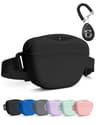
The heouvo. It is silicone, so it survives the treats that work; the magnets open one-handed; 1.67 cups is the right amount rather than the impressive amount; the waist belt is a belt and not a clip; and the clicker is included. It costs less than every fabric pouch here.
If your rewards are genuinely wet — cheese, chicken, anything you would not leave in a bag overnight — take the RBibei instead, because it is the only pouch on this page whose listing says you can put it in the dishwasher. Accept the 1-cup capacity and the clip-only carry.
Buy a fabric pouch for one reason: it carries things a treat pouch does not. The PetSafe Sport if you want one bag to hold the phone, the keys and the bags as well, with the fastest open on the page. The Kurgo if the walk is a trail or it is dark, accepting the drawstring. The OllyDog if you want the nicest everyday waist pouch and will hand wash it. The Mighty Paw if you walk two dogs and want the poop bags built in.
The Ruffwear is a good product and we are not going to pretend otherwise — the moldable rim is a real idea nothing else here has. But it is the same magnetic one-handed mechanism as the ten-dollar pouch, and on a value site that comparison is the review.