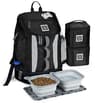
What separates a good one from a duffel bag
- Sealed food containers. Every pick here includes at least two. This is the feature that turns a bag into a system: kibble in a sealed cylinder does not migrate into the bedding, and you can measure meals out without a scoop.
- Collapsible bowls that live in the bag. The AKC specifically suggests packing collapsible travel bowls rather than the dog’s usual ones. If they live in the bag, they are never the thing you forgot.
- Somewhere for wet and dirty things. The Mobile Dog Gear’s drop-bottom compartment is the best version of this in the group: a separate zipped section underneath, so a soaked towel and a muddy harness do not ride with the food.
- A waste-bag dispenser. Trivial-sounding, used constantly.
- Carry options. A luggage sleeve matters if you fly or do hotels; backpack straps matter if you walk from a car park. Pick for how you actually travel.
- Wipe-clean lining. Something will leak. Water-repellent oxford or a PEVA lining means it wipes rather than soaks.
Capacity: what the numbers mean in practice
Only some of these publish a volume, which is itself informative — the Mobile Dog Gear listing states no overall capacity at all, so we have marked it not published rather than estimating one. Where the figures exist:
| Bag | Stated capacity | What that covers |
|---|
| PetAmi tote | 33 L, plus 2 x 5 L containers | A week away for a medium dog, comfortably |
| IGOLUMON set | 25 L, plus 2 x 5 L containers | Long weekend plus a feeding mat and blanket |
| ANILD backpack | Not stated; 2 canisters + bowls | Overnights and day trips |
| Mobile Dog Gear | Not stated; 2 carriers + 2 bowls | Week away, with the dirty kit separated |
A useful rule: a five-liter container holds roughly a week of kibble for a small dog and a few days for a large one. If you have a big dog and travel for a week, plan on the food traveling in its own bag regardless of what these hold.
On “airline approved”
Three of these use the phrase. It means the manufacturer believes the dimensions fit standard cabin allowances — it is not an accreditation, and no airline has certified any of them. Airlines set their own carry-on rules and change them. If you are flying, measure the bag against your specific carrier’s published dimensions and treat the claim on the box as marketing.
Worth separating too: this is a bag for the dog’s things. It is not a carrier and no dog goes in it. If you need to get the dog itself into a cabin, that is a different product entirely.
What to actually put in it
Built from the AKC’s road-trip and camping guidance, this is the pack list that keeps a bag genuinely useful rather than a place things go missing:
- Regular food, measured, sealed — plus a day’s spare
- Water, and collapsible bowls for food and water
- Any medication, in its original labeled packaging
- A copy of vaccination records and a recent photo of the dog
- Waste bags, more than you think
- A spare leash, because leashes get lost and broken
- A familiar blanket or bed cover — the smell settles a dog in a new room
- A towel, in the dirty compartment, permanently
- The number of a 24-hour emergency vet near your destination
Two things that should not live in the bag: the dog’s car restraint, which belongs in the car, and anything perishable.