Collar Creek

The best dog bowls

Two peer-reviewed studies went looking for an effect of bowl material on the bacteria in a dog's dish. One found none. The other found metal worse than plastic. What decides a clean bowl is the washing — and that changes what you should buy.

By Stephen V.Updated How we research

Every buying guide in this category opens the same way: stainless steel is the hygienic one, ceramic is the pretty heavy one, plastic is the one that harbors bacteria. It is a tidy hierarchy, it sells more expensive bowls, and two separate research teams have now measured it.

Neither of them found what the hierarchy predicts. A North Carolina State University team, publishing in PLOS ONE in 2022, swabbed household dog dishes and reported that bowl material had no significant effect on the bacterial counts they measured before any hygiene treatment was applied. A University of Turin team, publishing in BMC Veterinary Research in 2023, sampled 96 dog food bowls and found total aerobic bacteria counts were higher in metal bowls than in plastic ones.

That is not an argument for buying a plastic bowl, and neither paper makes one. It is an argument that the material is not the lever you think it is. The lever is the washing — and the same NC State study found that when households were given the FDA’s pet food handling guidance to follow, their dishes came back with a 1.5 log drop in aerobic plate counts, while the control group got slightly worse.

So this page buys for the washing. Cheap, dishwasher-safe, and two of them, so one is always in the machine. Everything below follows from that.

Quick picks

Ranked on specs, value and fit. Select a row to jump to the full write-up. We have not tested these ourselves — here is exactly what we do instead.

#ProductBest forPrice
1
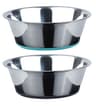
Amazon Basics Stainless Steel Non-Skid Dog Bowls, 38 oz (2-Pack)

Amazon Basics Stainless Steel Non-Skid Dog Bowls, 38 oz (2-Pack)

Two dishwasher-safe steel bowls with rubber bases for the price of one boutique dish. That 2-pack is the whole argument: the research says a clean bowl comes from washing it, not from what it is made of, and owning a spare is what makes washing it after every meal actually happen.

Best overall
$14.69 · View on Amazon

Price as of September 15, 2026. #ad How we’re funded

2
Pro Select Stainless Steel Classic Dog Bowl, 2-Quart

Pro Select Stainless Steel Classic Dog Bowl, 2-Quart

The cheapest honest bowl on this page, and the one that proves the point. A plain 18/8 stainless dish, 64 oz, no coating, no logo, nothing to chip or peel. If you have a dishwasher and a spare inch of floor, this is all the bowl most dogs need.

Best value
$8.19 · View on Amazon

Price as of September 15, 2026. #ad How we’re funded

3
PEGGY11 Nonslip Stainless Steel Dog Bowls, 7.6 Cup (2-Pack)

PEGGY11 Nonslip Stainless Steel Dog Bowls, 7.6 Cup (2-Pack)

The same cheap-steel formula scaled to a big dog: 7.6 cups each, 8.5 inches across, silicone underneath, two in the box. A pair covers food and water for a Labrador-sized dog and still costs less than one boutique ceramic dish.

Best for a large dog
$16.99 · View on Amazon

Price as of September 15, 2026. #ad How we’re funded

4
PEGGY11 Deep Stainless Steel Dog Bowls, 3 Cup (2-Pack)

PEGGY11 Deep Stainless Steel Dog Bowls, 3 Cup (2-Pack)

The small-dog version of the same idea, with a deeper profile and a flat rim that makes the bowl easier to lift when it is full. Three cups each is right for a dog under roughly 25 lb, and the pair stacks when one is in the machine.

Best for a small dog
$13.99 · View on Amazon

Price as of September 15, 2026. #ad How we’re funded

5
MORA Ceramic Pet Bowl, Medium (28 oz)

MORA Ceramic Pet Bowl, Medium (28 oz)

The one ceramic bowl here that addresses the thing that should actually worry you about ceramic. Mora states on its own listing that there is no US regulation for lead in pet products and that its glaze is lead-free - a claim almost nobody else in this category puts in writing, where you can hold them to it.

Best ceramic
$19.99 · View on Amazon

Price as of September 15, 2026. #ad How we’re funded

6
UPSKY 35 oz No-Spill Pet Water Bowl

UPSKY 35 oz No-Spill Pet Water Bowl

A floating disk sits on the water so the surface cannot slosh over the rim, and a waterproof edge strip catches what does. If your dog is a slobbery drinker or the water lives near a rug, this is a cheap fix for a problem no amount of stainless steel solves.

Best for a messy drinker
$15.99 · View on Amazon

Price as of September 15, 2026. #ad How we’re funded

7
Tafelf 15-Degree Tilted Stainless Steel Dog Bowl (M)

Tafelf 15-Degree Tilted Stainless Steel Dog Bowl (M)

A stainless bowl set at 15 degrees in a melamine stand, which is the shape that lets a short-muzzled dog get into its food instead of pushing it round the dish. Know before you buy that it is also an elevated feeder, so the AKC's bloat caution applies to it and not to the flat bowls above.

Best for a flat-faced dog
$19.99 · View on Amazon

Price as of September 15, 2026. #ad How we’re funded

The picks in full

#1Best overall

Amazon Basics Stainless Steel Non-Skid Dog Bowls, 38 oz (2-Pack)

Two dishwasher-safe steel bowls with rubber bases for the price of one boutique dish. That 2-pack is the whole argument: the research says a clean bowl comes from washing it, not from what it is made of, and owning a spare is what makes washing it after every meal actually happen.

Strengths

  • Two bowls in the box, so one is in the dishwasher while the other is on the floor
  • Rust-resistant stainless with a rubber non-skid base, stated dishwasher-safe
  • Amazon publishes both a max fill (38 oz / 1.15 L) and a recommended fill (28 oz / 0.8 L) - a rare honest capacity figure in this category

Trade-offs

  • The usable figure is the 28 oz recommended fill, not the 38 oz on the label - size up if you feed a big dog a big meal
  • 10.1 in across and 2.8 in high: wide and shallow, which is the wrong shape for a long-eared dog
  • Steel is light, so a determined shover can still walk it across a wet floor despite the rubber ring
MaterialStainless steel, rubber base
Capacity38 oz / 1.15 L max fill; 28 oz / 0.8 L recommended
Dimensions10.1" across x 2.8" high
In the box2 bowls
Dishwasher safeYes

Specs read from the product listing on September 15, 2026. “Not published” means the brand does not state that figure.

#2Best value

Pro Select Stainless Steel Classic Dog Bowl, 2-Quart

The cheapest honest bowl on this page, and the one that proves the point. A plain 18/8 stainless dish, 64 oz, no coating, no logo, nothing to chip or peel. If you have a dishwasher and a spare inch of floor, this is all the bowl most dogs need.

Strengths

  • 18/8 stainless steel, which the listing calls scratch-resistant - the property that matters for hygiene
  • 64 oz in one dish: a large dog's water for the day without a refill
  • No rubber, no coating and no printed logo, so there is nothing to peel away and trap residue

Trade-offs

  • No non-skid base at all - it slides, and it rings on a hard floor
  • The listing never claims dishwasher-safe, even though plain 18/8 steel is the easiest material there is to wash
  • Pro Select states that the "inside label may differ from picture", so the cosmetics are not guaranteed
Material18/8 stainless steel
Capacity64 oz / 2 quarts
Dimensions8.3" across x 2.5" high
Non-skid baseNo
Dishwasher safeNot published

Specs read from the product listing on September 15, 2026. “Not published” means the brand does not state that figure.

#3Best for a large dog

PEGGY11 Nonslip Stainless Steel Dog Bowls, 7.6 Cup (2-Pack)

The same cheap-steel formula scaled to a big dog: 7.6 cups each, 8.5 inches across, silicone underneath, two in the box. A pair covers food and water for a Labrador-sized dog and still costs less than one boutique ceramic dish.

Strengths

  • 7.6 US cups each - a large dog's water in one bowl instead of three refills
  • Wide, stable shape with a silicone non-slip bottom to cut sliding and noise
  • Stainless, dishwasher-safe and stackable, so the spare lives in a cupboard

Trade-offs

  • Wide and shallow at 2.6 in high: a fast eater will still push kibble over the rim
  • PEGGY11 does not publish the steel grade, which Pro Select does
  • Genuinely too big for a small dog - a 7.6 cup bowl invites overfeeding if you eyeball portions
MaterialStainless steel, silicone base
Capacity7.6 US cups each
Dimensions8.5" across x 2.6" high
In the box2 bowls
Steel gradeNot published
Dishwasher safeYes

Specs read from the product listing on September 15, 2026. “Not published” means the brand does not state that figure.

#4Best for a small dog

PEGGY11 Deep Stainless Steel Dog Bowls, 3 Cup (2-Pack)

The small-dog version of the same idea, with a deeper profile and a flat rim that makes the bowl easier to lift when it is full. Three cups each is right for a dog under roughly 25 lb, and the pair stacks when one is in the machine.

Strengths

  • Deeper profile than a standard small dish, so food stays inside it
  • Silicone base to cut sliding and noise on tile or laminate
  • Flat rim is genuinely easier to pick up full; dishwasher-safe and stackable

Trade-offs

  • 3 cups each is small - a medium or large dog will empty it in a sitting
  • "Deep" is relative: 2.4 in high and 6.89 in wide is still a wide mouth, not a well
  • Same missing steel grade as the larger PEGGY11 pair
MaterialStainless steel, silicone base
Capacity3 US cups each
Dimensions6.89" across x 2.4" high
In the box2 bowls
Steel gradeNot published
Dishwasher safeYes

Specs read from the product listing on September 15, 2026. “Not published” means the brand does not state that figure.

#5Best ceramic

MORA Ceramic Pet Bowl, Medium (28 oz)

The one ceramic bowl here that addresses the thing that should actually worry you about ceramic. Mora states on its own listing that there is no US regulation for lead in pet products and that its glaze is lead-free - a claim almost nobody else in this category puts in writing, where you can hold them to it.

Strengths

  • Brand states a lead-free glaze and says outright that lead is unregulated in US pet products
  • Listed as microwave, dishwasher and oven safe, so the FDA's hot-water rule is easy to follow
  • Rounded inside corners and a heavy base - weight is what stops a ceramic bowl traveling

Trade-offs

  • Ceramic chips, and a chipped glaze is a crevice; the AKC's warning about scratched or cracked bowls bites harder here than on steel
  • Sold singly at 28 oz, so a food-and-water pair costs double and there is no spare for the dishwasher
  • Mora does not publish the bowl's weight, which is the one spec you would actually want on a heavy bowl
MaterialCeramic, lead-free glaze (brand claim)
Capacity28 oz / 4 US cups
Dimensions7" across x 2.5" high
In the box1 bowl
Dishwasher safeYes - brand also states microwave and oven safe
WeightNot published

Specs read from the product listing on September 15, 2026. “Not published” means the brand does not state that figure.

#6Best for a messy drinker

UPSKY 35 oz No-Spill Pet Water Bowl

A floating disk sits on the water so the surface cannot slosh over the rim, and a waterproof edge strip catches what does. If your dog is a slobbery drinker or the water lives near a rug, this is a cheap fix for a problem no amount of stainless steel solves.

Strengths

  • Floating disk plus a waterproof edge strip - the two together are what stop the splash
  • Slows a gulping drinker and keeps muzzle hair out of the water
  • Dishwasher-safe, and the floating border detaches so you can clean underneath it

Trade-offs

  • The listing never states what the bowl is made of - on a page about bowl materials, that silence is the finding
  • UPSKY suggests cleaning the floating border twice a week; the FDA's rule for a food or water bowl is soap and hot water after each use, so follow the FDA
  • Water only. It is an addition to a steel pair, not a replacement for one
MaterialNot published
Capacity35 fl oz
Spill controlFloating disk + waterproof edge strip
In the box1 bowl
Dishwasher safeYes

Specs read from the product listing on September 15, 2026. “Not published” means the brand does not state that figure.

#7Best for a flat-faced dog

Tafelf 15-Degree Tilted Stainless Steel Dog Bowl (M)

A stainless bowl set at 15 degrees in a melamine stand, which is the shape that lets a short-muzzled dog get into its food instead of pushing it round the dish. Know before you buy that it is also an elevated feeder, so the AKC's bloat caution applies to it and not to the flat bowls above.

Strengths

  • 15-degree tilt brings the food to the muzzle, which is the actual reason flat-faced dogs struggle with a flat dish
  • The bowl is stainless and lifts out of the stand, so the part that touches food is a plain steel dish
  • Non-slip stickers and a wide melamine base keep it still during a meal

Trade-offs

  • It stands 5.9 in tall - this is an elevated feeder, and the AKC says elevated bowls may raise bloat risk. Ask your vet first
  • 420 ml / 1.5 cups in the medium, sold as one bowl rather than a pair
  • Tafelf does not state that it is dishwasher-safe, and the A5 melamine stand is the part that will scuff and stain
MaterialStainless steel bowl, A5 melamine stand
Tilt15 degrees
Capacity420 ml / 1.5 US cups (M)
Height5.9"
In the box1 bowl
Dishwasher safeNot published

Specs read from the product listing on September 15, 2026. “Not published” means the brand does not state that figure.

What the two studies actually measured

The NC State work surveyed 417 dog owners and then swabbed 68 food dishes in real homes. Its headline finding is about people, not bowls: fewer than 5% of respondents were aware that the FDA publishes pet food handling guidelines at all. Most expected that kind of information to be on the food label, or to come from their vet. On washing frequency, the largest single group — 22% of respondents — reported cleaning the dish about once a week, 12% did it daily, and 18% washed it less often than once a quarter.

Then the researchers split households into groups. One was asked to follow the FDA’s pet food handling guidance. One was asked to follow that plus the stricter FDA Food Code requirements, including washing at above 160 °F for at least 30 seconds. One was given no instructions. The first group’s dishes dropped 1.5 log units in total aerobic plate count, the second dropped 0.6, and the control group drifted slightly upward. Bowl material, measured before any of that started, made no significant difference.

The Turin study approached it from the other end: 351 dog caregivers surveyed, then 96 dog food bowls sampled for total mesophilic aerobic counts, Enterobacteriaceae, and three named pathogens. Metal bowls carried higher aerobic counts than plastic ones, and bowls used for wet food carried higher counts than bowls used for dry. Bowls washed by hand carried more Enterobacteriaceae than bowls that went through a dishwasher.

Two honest caveats, because they matter. Metal was also by far the most common material in that sample — 67.1% of the dog bowls surveyed — and the paper reports an association, not a mechanism; it does not claim that steel attracts bacteria. And the reassuring part of the result rarely gets quoted: no Salmonella, no Campylobacter and no verotoxigenic E. coli was detected in any of the 96 bowls. This is a hygiene question, not an emergency.

The rule that follows: buy two, and buy dishwasher-safe

The FDA’s instruction is one sentence long and almost nobody follows it: “Wash pet food bowls and scooping and measuring utensils with soap and hot water after each use.” The same page adds the rule people break daily — do not use your pet’s food bowl as a scoop; keep a separate cup or scoop for the food and wash that too.

Read that against the two studies and the buying decision writes itself. If the washing is what moves the number, then the specification that matters most on a dog bowl is how easy it is to wash properly. That means two things in practice.

Dishwasher-safe, stated on the listing.The stricter protocol in the NC State study wanted water above 160 °F, which is hotter than most people will run over their own hands at a sink, and the Turin data found hand-washed bowls carried more Enterobacteriaceae than machine-washed ones. A dishwasher does the temperature and the drying without any willpower. Two of the bowls below do not carry a dishwasher claim, and we say so in their cons rather than assuming one.

Buy a pair, not a bowl. A single bowl cannot be in the dishwasher and on the floor at the same time, which is precisely why the dish gets rinsed rather than washed. Three of our picks come two to a box for under twenty dollars, which is the cheapest behavior change available in this category.

Materials, honestly

With the hygiene hierarchy set aside, the materials still differ — just on durability, weight and what happens when they get damaged, which is where the AKC’s own guidance is genuinely useful.

MaterialWhat it is good atThe catch
Stainless steelThe AKC calls it the most durable option: easy to clean, dishwasher-safe, does not leach chemicals, hard to breakLight, so an active dog can shove it around unless it has a rubber or silicone base
CeramicHeavy, which the AKC notes makes it a good choice for large dogs and puppies that play with their bowlsNot always dishwasher-safe, chips or breaks if dropped, and must be made with a non-toxic food-grade glaze
PlasticCheap, light, often dishwasher-safeEasy for a dog to push around, and easy for a dog to scratch — and a scratch is a crevice
Melamine or resin trimUsed for stands and outer shells; cheap way to add weight and a colorIt is the part that scuffs and stains, and it is rarely the part the brand publishes a care instruction for

The thread running through the right-hand column is damage, not material. A chipped ceramic glaze and a scratched plastic bowl are the same problem: a surface that no longer wipes clean. That is the honest case for steel — not that it starts cleaner, but that it stays smooth for years.

Lead, and why a ceramic bowl needs a named glaze

One claim on the Mora listing is worth quoting because it is unusually candid about the brand’s own category: Mora states that lead “is in a lot of ceramic glazes since there is no US regulation for lead in pet products,” and that its glazes are lead-free.

We cannot verify a glaze from a listing, and we are not going to pretend otherwise. What we can verify is which brands put the claim in writing. If you want a ceramic bowl, buy one where the seller commits to a lead-free, food-grade glaze on the page — and skip the unbranded decorative bowls that say nothing about what is on the inside. The AKC makes the same point in weaker language when it says a ceramic bowl must be made with non-toxic, food-grade ceramic.

Size and shape: three measurements, not one

Capacity, read twice. The number in the product title is the capacity to the rim, and it is not the number you feed from. Amazon is unusually straight about this on the bowls we picked as best overall: max fill 38 oz, recommended fill 28 oz. Assume the same gap of roughly a quarter on every bowl in this category and size up accordingly.

Width against depth.Most cheap steel bowls are wide and shallow, because that shape is cheap to press. It is also the shape a fast eater scatters kibble out of, and the shape that dunks a long-eared dog’s ears in the food. The AKC’s advice for spaniel-type ears is a narrow-mouthed bowl so the ears hang outside it. Our small-dog pick is the deepest profile here at 2.4 in, and we will say plainly that it is still not a narrow bowl.

Height, which is a separate decision.A flat bowl on the floor is the default and should stay the default unless you have a reason. Raising a bowl is a comfort intervention for a tall, arthritic or diagnosed dog — and the AKC’s position is that elevated bowls may increase the risk of bloat, with the evidence conflicting enough that no firm recommendation can be made. Our tilted pick for flat-faced dogs is an elevated feeder, and its cons say so. If that decision is live for you, read are elevated dog bowls actually good before you buy anything.

Why we are not recommending a purpose-built “spaniel bowl”

The AKC’s narrow-mouth advice for long-eared breeds is sound, and there is a whole sub-category of bowls sold on it. We looked at them and did not pick one, for two reasons that matter on this page in particular.

The listings we resolved do not state what the bowls are made of — the material section says things like “smooth non-porous materials,” which is a description, not a material. On a page whose entire argument is about washing surfaces, we are not going to recommend a bowl whose surface is undisclosed. And several of them are elevated and sold with the claim that raising the bowl helps prevent bloating, which is the opposite of what the AKC says. A product page that contradicts the AKC on the one health claim in the category is not a product page we want to send a reader to.

Until one of them publishes a material, the practical answer for a spaniel-eared dog is the narrowest, deepest plain dish you can find, washed on the same schedule as everything else here. We will add a pick to this page when a listing earns it.

Which bowl page you actually want

“Dog bowl” covers four different problems, and only one of them is solved by the bowls on this page.

  • Your dog eats too fast.A ridged bowl is the fix, not a bigger dish — see the best slow feeder bowls.
  • Your dog is tall, stiff or diagnosed.A stand is the fix, with the bloat caveat attached — see the best elevated dog bowls.
  • Your dog will not drink enough.A circulating bowl is the usual answer, and it is the one category where we end up telling most owners they do not need one — see the best dog water fountains.
  • You just need something to put the food in.That is this page. The bin the food came out of is a separate question, and the FDA has opinions about that too — see the best dog food storage containers.

What we would actually buy

For most dogs, the Amazon Basics pair. Two rust-resistant steel bowls with rubber bases, both stated dishwasher-safe, for less than a single designer dish — and the spare is what makes the FDA’s after-every-meal rule survivable. Add the Pro Select 2-quart as a third bowl if you want a cheap backup for the days the dishwasher is still running.

Scale it to the dog from there: the 7.6-cup PEGGY11 pair for a Labrador-sized dog that empties a bowl by mid-afternoon, the 3-cup pair for anything under roughly 25 lb. If your dog treats a steel bowl as a hockey puck, the Mora ceramic is the heavy alternative from a brand that names its glaze — just accept that you are buying one bowl, not two.

Two specialist buys, both additions rather than replacements. The UPSKY floating disk if the water bowl is flooding your floor. And the Tafelf tilted bowl if your dog is short-muzzled and pushes food around a flat dish — after you have talked to your vet about the elevation, not before.

Whatever you buy, the thing that changes the number in those two studies is not on this page. It is soap, hot water, and doing it after every meal.

Frequently asked questions

What is the best material for a dog bowl?

On the hygiene grounds usually given, no material has been shown to win. A 2022 PLOS ONE study from North Carolina State University found bowl material had no significant effect on bacterial counts before any hygiene treatment, and a 2023 BMC Veterinary Research study of 96 bowls found total aerobic counts were higher in metal bowls than plastic ones. Stainless steel is still the sensible default, but for durability reasons: the AKC calls it the most durable option, it is dishwasher-safe, it does not leach, and unlike ceramic or plastic it does not develop chips and scratches that stop wiping clean.

Are stainless steel dog bowls really more hygienic?

Not automatically. In the 2023 Turin study, metal bowls carried higher total aerobic bacteria counts than plastic ones - though metal was also the most common material in the sample, and the paper reports an association rather than a cause. What steel genuinely gives you is a surface that stays smooth: it does not chip like a glaze or scratch like plastic, so it keeps cleaning easily for years. Hygiene comes from washing it, not from owning it.

How often should you wash a dog bowl?

After every meal. The FDA's guidance is to wash pet food bowls and any scooping or measuring utensils with soap and hot water after each use. Most people are nowhere near that: in the NC State survey, the largest group washed the dish about once a week, 12% washed it daily and 18% washed it less often than once every three months. Fewer than 5% of those owners knew the FDA guidance existed at all.

Is it better to wash a dog bowl in the dishwasher or by hand?

The dishwasher, if the bowl is rated for it. The 2023 Turin study found Enterobacteriaceae counts were higher in bowls washed by hand than in bowls run through a dishwasher, and the stricter protocol in the NC State study called for water above 160 degrees Fahrenheit for at least 30 seconds - hotter than most people will run at a sink. A machine hits the temperature and dries the bowl without any willpower, which is why we treat a stated dishwasher-safe claim as the most useful spec on a bowl listing.

Are ceramic dog bowls safe?

They can be, but you need the seller to commit to the glaze. Mora states on its own listing that lead is present in many ceramic glazes because there is no US regulation for lead in pet products, and that its glazes are lead-free. We cannot verify a glaze from a listing; what we can do is buy only where the claim is made in writing. The AKC's version of the same advice is that a ceramic bowl must be made with non-toxic, food-grade ceramic. Retire any ceramic bowl once it chips, because the chip is a crevice.

What size dog bowl do I need?

Read the capacity twice. The figure in the product title is usually the fill to the rim, not the working capacity - the Amazon Basics bowls on this page publish both, at 38 oz max fill and 28 oz recommended, and that roughly one-quarter gap is typical across the category. As a starting point, 3 cups per bowl suits a dog under about 25 lb, and 7 to 8 cups suits a large breed's water bowl. When you are between sizes, the bigger water bowl is the safer error.

What kind of bowl is best for a flat-faced dog like a French Bulldog?

A tilted or slanted bowl. A short-muzzled dog cannot get into the bottom of a deep vertical dish easily, so a 15-degree tilt brings the food to the muzzle instead. The trade-off is that most tilted bowls sit in a raised stand - the one on this page stands 5.9 inches tall - and the AKC's position is that elevated bowls may increase the risk of bloat. That makes this a conversation with your vet rather than a straight product choice.

What bowl is best for a dog with long ears?

A narrow-mouthed bowl, so the ears hang outside it rather than in the food - that is the AKC's own recommendation for long-eared breeds. We deliberately have not picked one of the purpose-built 'spaniel bowls' here: the listings we resolved do not state what the bowls are made of, and several are elevated and sold with a claim that raising the bowl helps prevent bloating, which contradicts the AKC. Until one publishes its material, the honest answer is the narrowest, deepest plain dish you can find.

Sources

Keep reading