Collar Creek

The best dog food storage container

Almost every buying guide in this category tells you to tip the kibble in. The FDA tells you not to. Getting that one decision right changes which container you should buy.

By Stephen V.Updated How we research

A dog food container is a twenty-dollar product that most people buy twice, because the first one turns out to be too small. That is not bad luck. It is what happens when you size a container against the number printed on the bag instead of against the bag itself — and against the way the FDA actually recommends you store dry food.

The FDA’s guidance is blunt: store pet food in its original bag, and if you want it in a container, “put the entire bag into the container rather than pour the kibble directly into it.” The reason is not fussiness. The bag carries the UPC code, the lot number and the “best by” date, and the FDA notes that fewer than half the pet food complaints it receives include a lot number — which is the single piece of information that lets it trace a bad batch.

Follow that rule and the shopping decision changes shape. You are no longer buying a bin that holds 40 lb of loose kibble; you are buying a bin that a 40 lb bag will physically fit inside. That means buying bigger than the label suggests, which is why our overall pick is the largest cheap container we could find rather than the best-sealed one.

How this is funded: we earn a commission if you buy through our links, at no extra cost to you. It never changes which product we recommend, and we’ll tell you when we’d skip one. Full disclosure.

Quick picks

Ranked on specs, value and fit. Select a row to jump to the full write-up. We have not tested these ourselves — here is exactly what we do instead.

#ProductBest forPrice
1
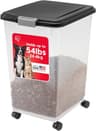
IRIS USA Dog Food Storage Container, 54 lb

IRIS USA Dog Food Storage Container, 54 lb

Sixty-nine quarts, an airtight seal with snap-lock latches, and casters you can leave off. It is the cheapest route we found to a container big enough to swallow a full-size bag of kibble, which matters more than it sounds: FDA guidance is to put the whole bag into the container rather than tip the kibble out, and most bins are too small to allow it.

Best overall
$34.99 · View on Amazon

Price as of September 15, 2026. #ad How we’re funded

2
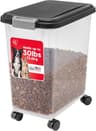
IRIS USA Airtight Pet Food Rolling Container, 33 qt

IRIS USA Airtight Pet Food Rolling Container, 33 qt

The listing is unusually straight with you: it is sold as a 30 lb container and the feature bullets say it holds roughly 22-26 lb of most kibble and that not all 30 lb bags will fit. Take the brand at its word, treat it as a 25 lb bin, and it is the best twenty-odd dollars in the category.

Best value
$23.99 · View on Amazon

Price as of September 15, 2026. #ad How we’re funded

3
Gamma2 Vittles Vault Pet Food Container, 20 lb

Gamma2 Vittles Vault Pet Food Container, 20 lb

The seal is the entire product. Gamma2's threaded locking lid with double gaskets is the tightest closure in this roundup, and the listing sells it on keeping pests out as hard as it sells freshness. If the food lives in a garage, a basement or a barn rather than a kitchen, this is the one.

Best seal
$34.99 · View on Amazon

Price as of September 15, 2026. #ad How we’re funded

4
Gamma2 Vittles Vault Airtight Container + Scoop, 50 lb

Gamma2 Vittles Vault Airtight Container + Scoop, 50 lb

The same Gamma Seal, sized for the 40 lb bag people with big dogs actually buy, with a scoop in the box. The most useful line on the listing is Gamma2's own sizing advice: for larger kibble, pick a container one or two sizes above the weight of the food, because capacity follows kibble shape and density rather than the number on the bag.

Best for a 40 lb bag
$57.70 · View on Amazon

Price as of September 15, 2026. #ad How we’re funded

5
Aloxina Stainless Steel Food Storage Bin, 38 qt

Aloxina Stainless Steel Food Storage Bin, 38 qt

Plastic is fine right up until something chews through it. Stainless is the answer for a garage, a mudroom, or a dog that has already broken into a bin once — 304 steel, a silicone-sealed clamp lid, and a body that does not hold fat or odor the way a scratched plastic bin eventually does.

Best stainless steel
$79.99 · View on Amazon

Price as of September 15, 2026. #ad How we’re funded

6
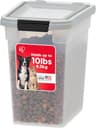
IRIS USA Dog Food Storage Container, 10 lb

IRIS USA Dog Food Storage Container, 10 lb

A small dog on a 5 lb bag does not need sixty-nine quarts, and a bin that takes three months to empty is a bin whose last third goes stale. Under twenty dollars, wide-mouthed enough to scoop from without knocking the sides, and small enough to live on a shelf.

Best for a small dog
$16.98 · View on Amazon

Price as of September 15, 2026. #ad How we’re funded

The picks in full

#1Best overall

IRIS USA Dog Food Storage Container, 54 lb

Sixty-nine quarts, an airtight seal with snap-lock latches, and casters you can leave off. It is the cheapest route we found to a container big enough to swallow a full-size bag of kibble, which matters more than it sounds: FDA guidance is to put the whole bag into the container rather than tip the kibble out, and most bins are too small to allow it.

Strengths

  • 69 qt is the largest capacity here, at a fraction of the stainless bin's price
  • Translucent body, so the level is visible without opening the lid
  • Casters attach or come off — a full bin is not something you drag

Trade-offs

  • The 54 lb rating assumes loose kibble; a bagged 40 lb sack leaves little headroom
  • Snap-lock latches, not the Vittles Vault's threaded double gasket
  • Translucent lets light in as well as out — keep it out of direct sun
Capacity69 qt / up to 54 lb (kibble dependent)
Dimensions17.98 x 14.76 x 23.44 in (21.88 in high without casters)
SealAirtight seal with snap-lock latches
CastersAttachable / removable
Scoop includedNot published

Specs read from the product listing on August 25, 2026. “Not published” means the brand does not state that figure.

#2Best value

IRIS USA Airtight Pet Food Rolling Container, 33 qt

The listing is unusually straight with you: it is sold as a 30 lb container and the feature bullets say it holds roughly 22-26 lb of most kibble and that not all 30 lb bags will fit. Take the brand at its word, treat it as a 25 lb bin, and it is the best twenty-odd dollars in the category.

Strengths

  • The brand publishes the real capacity (about 22-26 lb) instead of only the headline number
  • Foam-lined snap-lock lid and attachable wheels at the lowest price here
  • 16.5 x 10.8 in footprint fits a pantry, a laundry room or a counter

Trade-offs

  • Polypropylene body is flexible rather than rigid — the listing says so
  • A 30 lb bag will not go in as a bag, so this one you decant
  • Listing does not mention an included scoop, unlike either Vittles Vault
Capacity33 qt / approx. 22-26 lb of kibble (stated)
Dimensions16.5 x 10.8 x 18.4 in (16.9 in high without wheels)
SealSnap-lock lid, foam-lined
MaterialBPA-free polypropylene (flexible, not rigid)
WheelsAttachable

Specs read from the product listing on August 25, 2026. “Not published” means the brand does not state that figure.

#3Best seal

Gamma2 Vittles Vault Pet Food Container, 20 lb

The seal is the entire product. Gamma2's threaded locking lid with double gaskets is the tightest closure in this roundup, and the listing sells it on keeping pests out as hard as it sells freshness. If the food lives in a garage, a basement or a barn rather than a kitchen, this is the one.

Strengths

  • Threaded locking lid with double gaskets, not snap latches
  • Food-grade BPA-free HDPE the brand states will not shatter if dropped
  • Rated by the brand for indoor, garage or covered outdoor use

Trade-offs

  • Costs more than the 54 lb IRIS while holding well under half as much
  • Opaque, so checking the level means opening it
  • A threaded lid is slower to open than a flip lid, twice a day, every day
CapacityUp to 20 lb (kibble dependent)
SealGamma Seal: threaded locking lid, double gaskets
MaterialFood-grade BPA-free HDPE
Dimensions12 x 12 x 18 in
Made inUSA (stated)

Specs read from the product listing on August 25, 2026. “Not published” means the brand does not state that figure.

#4Best for a 40 lb bag

Gamma2 Vittles Vault Airtight Container + Scoop, 50 lb

The same Gamma Seal, sized for the 40 lb bag people with big dogs actually buy, with a scoop in the box. The most useful line on the listing is Gamma2's own sizing advice: for larger kibble, pick a container one or two sizes above the weight of the food, because capacity follows kibble shape and density rather than the number on the bag.

Strengths

  • Gamma Seal closure at a size that suits a 40 lb bag
  • Scoop included, so you are not using the dog's bowl to measure
  • Same food-grade HDPE and stated USA manufacture as the 20 lb

Trade-offs

  • Costs nearly twice the larger-capacity IRIS bin
  • No wheels, and 50 lb of kibble is not something you lift
  • 20.2 in tall — measure the cupboard before ordering
CapacityUp to 50 lb (kibble dependent)
SealGamma Seal: threaded locking lid
MaterialFood-grade HDPE
Dimensions14 x 14 x 20.2 in
Scoop includedYes

Specs read from the product listing on August 25, 2026. “Not published” means the brand does not state that figure.

#5Best stainless steel

Aloxina Stainless Steel Food Storage Bin, 38 qt

Plastic is fine right up until something chews through it. Stainless is the answer for a garage, a mudroom, or a dog that has already broken into a bin once — 304 steel, a silicone-sealed clamp lid, and a body that does not hold fat or odor the way a scratched plastic bin eventually does.

Strengths

  • 304 stainless: the listing states rust-resistant, odor-free and chew-proof
  • Silicone-sealed lid with a clamp closure rather than snap latches
  • Stainless scoop included

Trade-offs

  • Comfortably more than twice the 54 lb IRIS, for less capacity
  • Opaque, and steel adds real weight before you put any food in
  • No wheels and no published gasket-replacement part
Capacity38 qt / up to 40 lb (stated)
MaterialFood-grade 304 stainless steel
SealSilicone-sealed lid, clamp closure
Dimensions11.2 x 11.2 x 20 in
Scoop includedYes, 304 stainless with a walnut handle

Specs read from the product listing on August 25, 2026. “Not published” means the brand does not state that figure.

#6Best for a small dog

IRIS USA Dog Food Storage Container, 10 lb

A small dog on a 5 lb bag does not need sixty-nine quarts, and a bin that takes three months to empty is a bin whose last third goes stale. Under twenty dollars, wide-mouthed enough to scoop from without knocking the sides, and small enough to live on a shelf.

Strengths

  • The cheapest container here and the right size for a 5-10 lb bag
  • Wide top and a secure latch, which the listing sells on easy scooping and cleaning
  • Translucent body shows the level at a glance

Trade-offs

  • The 10 lb rating still depends on kibble shape — the listing says so
  • Same snap-latch seal as the bigger IRIS bins, not a Gamma Seal
  • Too small to take a bagged 10 lb sack, so this one you decant
CapacityUp to 10 lb (kibble dependent)
Dimensions11.62 x 9.07 x 12.40 in
SealAirtight seal with snap-lock latches
MaterialBPA-free, made in USA (stated)
Scoop includedNot published

Specs read from the product listing on August 25, 2026. “Not published” means the brand does not state that figure.

The rule that decides everything: bag in, kibble out

Two independent authorities land in the same place. The FDA’s storage page says to keep food in the original bag, and if you use a container, to put the whole bag inside it. The American Kennel Club’s guidance on whether dog food expires makes the same recommendation and explains the chemistry: dry food exposed to air undergoes lipid oxidation, which breaks fat molecules down and turns the food rancid. Tip a bag into a bin and you expose every piece at the bottom to air and light for as long as it sits there.

The bag is a barrier. It is also the label. Between those two jobs, the bag is doing more work than the container is, and the container’s actual role is to be a rigid, sealed, chew-proof, pest-proof box around it.

If you genuinely cannot fit the bag in — a small bin, a small cupboard, a 25 lb sack — the FDA still tells you what to do. Use a container that is clean, dry and has a snugly fitting lid, and save the UPC code, lot number, product name, manufacturer and best-by date. Its suggestion is to cut that panel out or write it down and tape it to the outside of the container, and to change it every time you open a new bag. It takes ten seconds and it is the only way a recall notice can ever mean anything to you.

Rated capacity is optimistic — every time

Every brand in this category rates its containers in pounds of kibble, and every brand also admits, further down the listing, that the real figure depends on kibble shape and density. Some are more honest about it than others, and the honesty is worth paying attention to when you choose.

IRIS sells the rolling bin below as a 30 lb container, then states in its own feature bullets that it holds approximately 22–26 lb of most dry kibble and that “not all 30 lb bags will fit.” Gamma2 puts it as advice rather than a disclaimer: for larger kibble, choose a container one or two sizes above the weight of the food. Both are telling you the same thing. Round up.

Your bagBuy at least
4–5 lbA 10 lb bin — decanting is fine at this size
15–20 lbA 30–35 lb bin if you want the bag to go in
30 lbA 50 lb bin or the 69 qt IRIS
40 lb+The largest bin that fits the space, every time

Those are our reading of the brands’ own sizing caveats, not a tested figure — we do not own these containers. Treat the row as a floor rather than a target.

Seals: latched, threaded, or clamped

There are three closures in this roundup and they are not equivalent.

  • Snap-lock latches (both IRIS bins) press a lid onto a seal. Fast to open, cheap to make, and perfectly adequate in a dry kitchen.
  • Gamma Seal (both Vittles Vaults) is a threaded lid that screws down onto double gaskets. It is the tightest closure here and the one Gamma2 markets on pest exclusion, not just freshness. It is also the slowest to open, twice a day, forever.
  • Clamped silicone (the Aloxina steel bin) compresses a silicone gasket with a lever. Effectively a jar lid at scale.

If the food lives in a kitchen, latches are fine and the speed is worth something. If it lives in a garage, a basement, a barn or a shed — anywhere that has ants, mice or humidity swings — buy the threaded seal and accept the daily unscrewing.

Plastic or stainless?

For most people, plastic. A food-grade BPA-free bin from IRIS or Gamma2 is rigid, sealed and costs a fraction of what a steel one does, and if you are keeping the bag inside it the plastic never touches the food at all.

Stainless earns its price in three specific situations: a dog that has already chewed or nosed its way into a bin, a space where rodents are a live problem, or a household that decants and has watched a plastic bin go greasy and faintly rancid-smelling over a couple of years. That film is residual fat, and it is exactly what the FDA is getting at when it says to wash and dry the container between finishing one bag and filling it with the next. Steel wipes clean; a scratched plastic bin does not, quite.

One caveat on steel that the listings do not lead with: it is opaque and it is heavy before you add any food. If checking the level at a glance matters to you, the translucent IRIS bins are genuinely more useful day to day.

Where you put it matters as much as what you buy

The FDA is specific about temperature: store dry pet food in a cool, dry place below 80 °F, because excess heat or moisture breaks the nutrients down. That rules out a lot of the places a big plastic bin naturally ends up — a sunny utility room, a garage in July, the top of a fridge where the compressor vents.

A translucent container adds a second consideration, since light drives the same oxidation the AKC describes. It is a small effect next to heat, but a clear bin on a windowsill is the one place you should not put it.

The other reason placement matters is the dog. A container that a dog can knock over, nose open or chew into stops being a storage problem and becomes a gorging risk, and a dog that eats a large volume of dry food fast is the exact scenario the AKC flags around bloat. If your dog is the determined type, the steel bin or a latched bin behind a closed door is the answer — and our slow feeder bowl guide covers the meal-speed half of the same problem.

The scoop, and the hygiene nobody thinks about

Two of the containers here include a scoop, and it is not a throwaway accessory. FDA guidance is explicit that you should not use your pet’s food bowl as a scooping or measuring utensil — use a clean scoop, spoon or cup kept only for pet food, and wash and dry it after each use.

The reason is the one people forget about dry food: it is food, and it can carry the same bacteria other food does. The FDA lists salmonellosis and listeriosis as real risks from pet food and treats, and recommends washing your hands for at least 20 seconds before and after handling it. None of that is a reason for alarm. It is a reason to keep a dedicated scoop in the bin and to wash the bin out between bags rather than topping up an old layer of crumbs with a fresh bag.

That last habit — pouring new food on top of old — is the most common mistake in the category. The bottom layer never leaves, and it is the layer with all the crushed fines and residual fat in it.

What we would actually buy

For most households: the 69 qt IRIS. It is around thirty dollars, it takes casters, and it is the only bin here big enough that putting the bag inside it is realistic for a large bag — which is the whole point.

For a medium dog on a 20–25 lb bag in a small kitchen: the IRIS rolling bin, treated as the 22–26 lb container the brand says it is.

For food kept in a garage or anywhere with pests: a Vittles Vault, sized one or two steps above your bag. For a dog that has already broken into a bin: the Aloxina steel. And for a small dog on a 5 lb bag, the little IRIS at under twenty dollars is all the container the job needs.

If you are setting a house up from scratch, the container is one line on a longer list — our new dog starter kit covers what to buy before the dog arrives, and the elevated bowl guide covers the feeding-station end of it.
Frequently asked questions

Should you pour dog food into a container or keep it in the bag?

Keep it in the bag. FDA guidance is to store pet food in its original bag, and if you want to use a container, to put the entire bag into the container rather than pour the kibble in. The bag is an oxygen barrier and it carries the UPC code, lot number and 'best by' date you would need in a recall — the FDA notes that fewer than half the pet food complaints it receives include the lot number.

What size dog food container do I need?

Bigger than the number on your bag. Every rated capacity in this category assumes loose kibble of an average shape and density — IRIS states its 30 lb rolling bin actually holds about 22-26 lb and that not all 30 lb bags will fit, and Gamma2 advises picking a container one or two sizes above the weight of your food. If you want the bag to go in whole, size up again.

Are airtight dog food containers actually better?

Yes, but for a narrower reason than the marketing implies. Dry food exposed to air undergoes lipid oxidation, which the AKC describes as breaking fat molecules down and turning food rancid. A sealed container slows that and keeps pests and humidity out. It does not make old food fresh, and it does not replace the bag's own barrier.

Is a stainless steel dog food container worth it?

For most people, no — a food-grade plastic bin is rigid, sealed and a fraction of the price, and if the bag stays inside it the plastic never touches the food. Steel earns its money in three cases: a dog that has already broken into a bin, a rodent-prone garage or barn, and a household that decants and has watched a plastic bin go greasy over a couple of years.

Where should dog food be stored?

Somewhere cool and dry, below 80°F — FDA guidance is explicit that excess heat or moisture causes the nutrients to break down. That rules out a hot garage, a sunny utility room and the top of a fridge. Keep a clear container out of direct light too, since light drives the same oxidation, and keep it somewhere the dog cannot knock it over or chew into it.

Do I need to wash a dog food container between bags?

Yes. The FDA recommends washing and drying the container between finishing one bag and filling it with another, to get residual fat and crumbs off the surfaces. Pouring a new bag on top of an old layer is the most common mistake here — the bottom layer never leaves, and it is where the crushed fines and old fat sit.

Can I use the dog's bowl to scoop food out of the container?

The FDA says not to. Use a clean scoop, spoon or cup kept only for pet food, and wash and dry it after each use — dry pet food can carry bacteria that cause salmonellosis and listeriosis, and the same guidance recommends washing your hands for at least 20 seconds before and after handling it. Two of the containers on this page include a dedicated scoop.

Sources

Keep reading