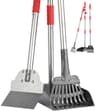
The four designs, side by side
| Tool | Design | Published reach | Hands | Bag needed | Best surface |
|---|
| TOOGE | Rake + tray | 38 in tray, 36 in rake | Two | No | Grass, dirt, gravel |
| Arm & Hammer | Claw | 27 in | One | No | Grass, concrete |
| ienjoyed | Claw | 36 in | One | No | Grass, concrete, dirt, gravel |
| FUSBUNTY | Rake + tray + spade | 38 in | Two | No | Grass, concrete, gravel |
| Pupzle | Rake + swivel bin, bag inside | 40 in | Two | Yes (drawstring) | Any yard |
| DogBuddy | Pocket scooper, bag inside | Not published | One | Yes (standard roll) | Walks, any surface |
The column that decides most purchases is hands, and almost no listing leads with it. A rake-and-tray set is excellent and completely unusable while you are holding a leash. If the picture in your head is a dog on a leash in a strip of grass, you want a claw or a pocket scooper, and the cheapest rake set in the world will not help you.
Reach is the specification. Everything else is a feature
Nearly everyone buying one of these is buying it because bending hurts, or because they are tired of it. That makes handle length the only number on the box that maps directly onto the reason you are shopping — and it is the number the cheap end of the category is quietest about.
The useful range is roughly 27 to 40 inches. At 27 inches, which is the Arm & Hammer claw, an average adult still leans noticeably. At 36 inches you work upright. The ienjoyed listing makes the argument against its own competitors better than we could: if you have difficulty bending because of an injury, a 36 inch tool is genuinely more helpful than a 24 or 28 inch one. That is not marketing. It is the whole product.
So measure before you buy. Stand with your arm hanging straight down and measure from your palm to the ground. That figure, minus an inch or two for the grip, is the handle length that lets you work without stooping. For most adults it lands somewhere between 30 and 36 inches, which is why the 36 inch tools feel like a different product rather than a longer one.
Why a claw beats a solid scoop on grass
This is the spec nobody explains and everybody notices on day one. A solid scoop or shovel has to get under the waste, which on a lawn means getting under the grass too — so you come away with a divot, and a week of that leaves a yard full of bare patches.
A claw has spaced teeth. The Arm & Hammer listing states the design intent directly: the spacing between the teeth grabs waste but leaves grass and gravel behind. That is the entire reason this design exists, and it is why a claw is the right tool on a lawn, on gravel and on bark mulch, where a shovel is the wrong one.
The ienjoyed goes the other way on one detail worth understanding: its teeth are stated to close seamlessly, so it leaks less and holds more, at the cost of bringing a little more of the surface with it. Neither approach is wrong. Wide spacing suits a lawn you care about; a closed claw suits concrete, gravel and a dog producing more than one tidy pickup at a time.
The soft-stool problem, and the one piece that solves it
Every tool here is designed around firm stool. Any dog that has eaten something it should not have, or is on a new food, or is simply old, will produce something a rake drags rather than lifts — and dragging on concrete or decking makes the situation considerably worse than leaving it alone did.
The only honest answer in this category is a spade, which slides underneath instead of raking across. One pick here includes one: the FUSBUNTY set ships a rake, a tray and a spade, which is why it is on this page despite being near-identical to the TOOGE in every other respect. If your dog’s gut is unreliable, buy the three-piece set and treat the spade as the reason.
On a hard surface, the genuinely effective method is still the free one: a plain bag over your hand, or a bag held in a pocket scooper, and then hose the spot. No long-handled tool deals well with soft stool on concrete, and a listing that claims otherwise has not tried it.
What picking it up is actually for
It is worth being specific, because “keep your lawn looking great” is how these products are sold and it is the least important reason to own one.
The CDC is direct about dog waste carrying parasites and germs that can infect people, and its guidance is to bag it and dispose of it. Its page on toxocariasis — dog and cat roundworm — sets out the route plainly: roundworm eggs are carried in animal feces and can get into people’s mouths through contaminated dirt or unwashed hands, and severe cases are more likely in young children who have been playing in or eating contaminated dirt.
That is the argument for picking up promptly rather than weekly, and it is also the argument for a tool rather than a bag over your hand if you have children using the same yard. We are not going to put a number on how long anything survives in soil, because the CDC page does not publish one and we are not going to invent one. The mechanism is enough: waste left on the ground becomes dirt that hands go into.
The practical corollary is that the tool itself is now contaminated. Hose it off outside, store it outside, and wash your hands afterward — which is exactly why we rank rust-proof metal and a hanging hook as highly as we do, and why a tool that has to be wiped rather than rinsed is a worse tool.
Where the bag goes, and what the bag claims mean
Two of these picks hold the bag for you. The Pupzle rakes straight into a drawstring bag inside a swivel bin; the DogBuddy takes a standard roll in the body and doubles as the holder until you reach a bin. Both remove the moment where you are trying to get a tray’s worth of waste into a bag you are holding open with two fingers, and for a multi-dog yard that moment is the whole reason the job gets put off.
Two cautions. First, the Pupzle’s bags are part of the product — when the 75 included drawstring bags run out you are buying bags that fit it, not whatever is in the drawer. Second, if a bag’s box says biodegradable or compostable, be careful what you take from that. FTC staff wrote to marketers and sellers of dog waste bags about exactly these claims, noting that most waste bags end up in landfills where no plastic biodegrades in anywhere close to a year, and that dog waste is generally not safe to compost at home while very few facilities accept it. We take that apart properly on whether compostable poop bags are really compostable.
Three things that make one of these last
Rinse it, do not wipe it. Every metal pick here is specified to be hosed. That is a real durability difference, because a tool you have to carry to a sink is a tool that gets wiped once and then put away dirty.
Store it as one object.A rake-and-tray set that lives as two loose poles is a set you will lose half of inside a season. The TOOGE clips together with a hanging hook, the FUSBUNTY’s three pieces snap together, the Arm & Hammer stands upright on its own and the ienjoyed folds in half. This sounds like a footnote and is the single most common reason these get replaced.
Count the moving parts.The rake sets have none. The claws have springs. The Pupzle has a spring, a swivel lid and a bag mechanism. More convenience, more to break — which is a reasonable trade for a multi-dog yard and a poor one for a single dog on a small lawn.
What we would actually buy
For a lawn and one dog, the TOOGE rake and tray. It is the cheapest stainless set that publishes its reach, it has nothing to fail, and it rinses. If that dog has an unreliable gut, pay the same money for the FUSBUNTY instead and use the spade.
If you want one hand free — because you are holding a leash, a phone or a child — buy a claw. The Arm & Hammer is the cheap, known-brand version and is the right answer for most people. Pay the extra for the ienjoyed only if 36 inches versus 27 is the point, which it is if your back is the reason you are on this page.
For a yard with two or more dogs, the Pupzleearns its price by removing the transfer step and sealing the smell between pickups — accepting that you are buying into its bags. And if most of your pickups happen on a walk rather than at home, the one to own is the DogBuddy, which costs the least of anything here and is the only pick that addresses the actual problem of doing this one-handed on a leash. It belongs in the same pocket as the treat pouch, and it is on the short list in our new dog starter kit.