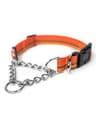
Width is the spec that does the work
A 3/4-inch collar on a Labrador concentrates any sudden load into a narrow band. A 1.5-inch collar spreads the same force over twice the area. That matters for comfort in normal use and it matters a great deal in the one second where your dog hits the end of the leash unexpectedly.
The trade-off is that very wide collars sit awkwardly on a dog with a short neck, and they are heavier to wear all day. For most large breeds an inch to an inch and a quarter is the sweet spot; go to 1.5 inches for the genuinely giant breeds and for dogs with heavy coats where a narrow collar disappears into the fur.
The three hardware failures
- Cast or bent D-rings. A ring that is a bent piece of wire with a gap where the ends meet will open under load. A welded ring will not. This is the single cheapest upgrade available and most budget collars skip it.
- Plastic side-release buckles. They are fine for everyday wear and they are the standard for good reasons — quick, cheap, no failure mode that involves a stuck pin. But on a large dog look for a heavy-duty buckle rather than the thin ones used on small-dog collars, or step up to a metal buckle if your dog is very strong.
- Stitching at the ring. The webbing is folded back on itself and sewn to hold the D-ring. A box stitch with a cross through it is what you want; a single line of stitching across the fold is what fails. You can see this on the product photos if you look.
Flat, martingale, or neither
A flat collar is the default: buckle it, fit it, leave it on for ID. It is the right answer for the large majority of large dogs.
A martingale exists for one specific geometry — a head that is narrower than the neck, which is common in sighthounds and bully types. On those dogs a flat collar simply slides off backwards. A martingale tightens to a limited, pre-set point when the dog pulls back, so it cannot be reversed out of, and then loosens again. It is not a correction device and should never be able to close to a choke.
Neither is the answer if your dog pulls hard on walks. That is a harness job, and no collar makes it a good idea.
Fitting a collar on a big dog
Two fingers flat between collar and neck — the same rule as a harness. On a heavily coated dog, take that measurement against the skin rather than on top of the coat, or you will end up with a collar the dog can back out of once the undercoat drops.
Then check the position. A collar should sit at the base of the neck, not high up under the jaw. High collars are what people fit when the collar is too small, and they put pressure exactly where the AKC’s harness-versus-collar guidance says you do not want it.
The ID question
A dog that slips its leash needs to be carrying identification, which is the strongest single argument for a collar even on a dog you always walk in a harness. Hanging tags work and they jingle; on a large dog living indoors that noise is a real irritant, which is why a collar with the details printed or embroidered directly onto the webbing is worth considering. Silent, unloseable, and it cannot be pulled off in a scuffle.