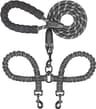
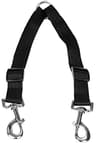
When a coupler works
- Two dogs of roughly similar size and strength — not necessarily identical, but within a range where one cannot simply drag the other.
- Both already walk reasonably on a loose leash. A coupler amplifies existing training; it does not create any.
- They like each other and are comfortable walking in close proximity for the whole walk.
- Predictable routes. Couplers are at their best on a known walk and at their worst somewhere new and stimulating.
When a coupler is the wrong tool
- A big dog and a small one. A 60 lb dog changing direction takes a 12 lb dog with it, and the small dog has no say in the matter.
- One dog reactive to something the other is not. The reactive dog lunges, the calm dog is dragged into the situation, and now you have two dogs in it.
- A dog still learning loose-leash walking. Training needs individual feedback, and a coupler makes every correction land on both dogs. Do the training separately — our loose-leash guide covers the method.
- Anywhere you might need to lift or move one dog quickly.
Integrated leash or coupler attachment?
| Integrated double leash | Coupler attachment |
|---|
| What it is | Handle, leash and splitter in one | Just the Y — clips to your leash |
| Failure points | Fewer | One extra join |
| Flexibility | Fixed length above the split | Use any leash you like |
| Single-dog use | Awkward — the split hangs | Just unclip it |
| Price | Higher | Lower |
If you walk both dogs together every day, the integrated leash is tidier and has one less thing to fail. If you sometimes walk one dog and sometimes both, the coupler attachment is more useful — and it lets you keep the handle you already like.
The bungee is worth paying for
Without it, one dog lunging transmits straight through the Y into the other dog’s harness. That is unpleasant for the dog that did nothing, and it is how a calm dog learns to be tense on walks.
An elastic section absorbs most of that. It also softens the load on your wrist, which with two dogs is the difference between a nice walk and an aching arm. Every pick here except the plain couplers has one.
Adjustable sides matter for mismatched pace
Two dogs rarely want to be exactly level. A coupler with independently adjustable sides lets the slower dog sit a few inches back rather than being towed level with the faster one, which removes a surprising amount of the friction between them.
That is the argument for the STGOOD, which adjusts each side between 15 and 20 inches. It is a small feature that fixes a real annoyance.
Clip both to harnesses, never to collars
This is not optional on a coupler. With two dogs sharing one line, one dog’s lunge becomes a sideways jerk on the other — and if that lands on a collar it lands on a throat. Harnesses spread it across the chest, where it belongs.
Back-clip harnesses work better than front-clip ones here, because a front ring on a coupler steers the dogs into each other. Keep the front clips for individual walks. See front clip vs back clip for the mechanics.
How to introduce it
Not on a busy street. Rig it in the garden or a quiet park, let them work out the geometry for ten minutes, and watch for the dog that keeps getting pulled off its line. If one dog is clearly the passenger rather than the participant, the coupler is not for these two dogs — and that is worth knowing before you find out at a junction.
If it works, expect a week of adjustment. Dogs that have always walked independently take a few outings to stop treating the other dog’s movement as a surprise.