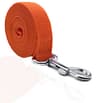
Clip weight is the spec nobody publishes
You will almost never find a clip weight in a listing, so judge it from the photograph and the leash width. A 5/8 in or 3/4 in leash generally carries a proportionate snap; a 1 in leash carries a snap sized for a dog four times heavier.
Two clip styles are worth knowing. A bolt snap is the spring-loaded sliding gate, and it is the lighter option. A trigger snap has a hinged lever and is stronger but heavier. For a small dog the bolt snap is fine and the weight saving is real.
A swivel between clip and webbing is worth having whatever the style. Small dogs circle, and a leash without a swivel turns into a twisted cord within a week.
Length: 5 ft or 6 ft, and why not shorter
Four-foot leashes get sold for small dogs on the theory that a small dog should stay close. In practice a short leash means you are correcting the dog constantly and it never gets to walk at its own pace, which is exactly how a dog learns that a tight leash is normal.
Five feet is the sensible default and six is fine on quiet paths. If you need the dog close for a road crossing, choke up on the leash with your hand — that is what the extra length is for.
Retractables are more defensible on a small dog
We are generally cautious about retractable leashes, and the reasons are well documented: cord burns, no reliable control at extension, and the failure mode where the brake does not stop a running dog in time. All of that still applies.
But the physics change with the dog. Most of the serious retractable injuries involve a heavy dog reaching speed at the end of a thin cord, and a 10 lb dog does not generate that. If you are going to use one, a small dog is the case where it is most defensible — on open ground, never near a road, and never on a collar. Our retractable leash roundup covers the safe-use rules properly.
Clip it to a harness, not a collar
A small dog that lunges at a passing dog puts its entire body weight against a narrow band on a small trachea. That is the case for a harness on any dog and it is stronger the smaller the dog gets.
The harness also solves the escape problem, which is worse on small dogs because a narrow head and a slim neck make backing out of a collar easy. Our small dog harness picks are the companion page, and harness vs collar covers the reasoning.
Reflective webbing, because of the sightline
A small dog at night sits below the beam of a car’s headlights until the car is close. A reflective leash puts a bright line at knee height that a driver sees earlier than the dog itself, which is a genuine safety gain for about two dollars.
Woven reflective thread rather than printed stripe, for the same reason as with harnesses: printing fades and the thread does not. If the walk is genuinely dark, add a light — see our LED collar picks.
Two dogs, one hand
A lot of small-dog households have two small dogs, and two separate leashes in one hand is how you end up untangling in the rain. A coupler is a few dollars and it fixes it — but only if the dogs walk at similar speeds. Our double dog leash guide covers when a coupler helps and when it makes things worse.
What we would actually buy
For most small dogs: the Voyager, at 5 ft, clipped to a harness. If you want spares for the car and the bag, the TAIAN at three dollars is genuinely fine for a light dog. For night walks in an unlit area, the Max and Neo reflective. And if you use a retractable, keep it for open ground and pair it with a fixed leash for anywhere with traffic.