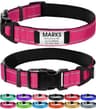
The three methods, and who each one is wrong for
This is the whole decision. Everything else — color, pattern, buckle style — is taste.
| Method | What it is | Wrong for |
|---|
| Embroidered | Name and number stitched through the webbing. Nothing sits proud of the collar, nothing jingles, nothing can detach. The YDL collar adds double-sided reflective stitching. | Anyone whose number might change — embroidery is permanent, and personalized items are generally not returnable. Also hard to read at a distance on a dark collar. |
| Fixed nameplate | A laser-etched stainless plate riveted flat to the collar. Silent like embroidery, but readable at arm’s length and still readable years later. The Joytale takes up to four lines. | A minimalist buyer: the Joytale’s neoprene lining adds bulk. And it is etched once, so a new number means a new collar. |
| Slide-on plate or code | A curved steel plate or a silicone QR body that threads onto the webbing of the collar you already own. GoTags engraves up to four lines; WhoseID holds an editable online profile. | Anyone who wants the ID guaranteed readable with no phone and no signal — a scannable code depends on the finder, an engraved number does not. Both are sized to collar width, so measure first. |
What the listings do and do not publish
Read off the registry entries behind the picks above, with live prices from November 22, 2026. Where a brand does not state a figure we record that rather than guess it.
| Pick | ID method | Reflective | Fit range |
|---|
| Joytale nameplate collar | Etched steel plate, up to 4 lines | Yes — reflective stitching | 5 sizes, XS to XL |
| YDL embroidered collar | Stitched name + phone number | Yes — double-sided stitching | 8.5–12, 10–15, 12–19, 14.5–23 in |
| GoTags reflective collar | Name + phone on the collar itself | Yes — reflective webbing | Not published |
| GoTags slide-on plate | Laser-engraved stainless plate | No | Collar widths 3/8, 5/8, 3/4, 1 in |
| WhoseID QR / NFC tag | Scannable code, editable profile | No | Collar widths 3/8 to 1 in |
Two things stand out. The collars publish reflectivity and the tags do not, which is the argument for personalizing the collar rather than bolting ID onto it. And only the YDL publishes real neck ranges in inches — on a product you cannot return because it has your number on it, a published range is worth more than a pattern you like.
What to put on it
Fewer lines, bigger characters. A phone number is the one thing a finder actually needs, so it should be the largest thing on the plate. Most people then add the dog’s name, which helps a stranger hold the dog’s attention. Our own order of preference:
- Your mobile number. One number, with the area code. A second number helps only if the first one might be off.
- The dog’s name. Useful for calming a found dog, and it is what makes people look twice at the collar.
- “Microchipped” or “Needs meds.” One short line that changes what a finder does. The AKC recommends keeping chip registration details current, and a collar that says the dog is chipped prompts a shelter to scan.
What to leave off: your home address, and the dog’s breed. An address tells a stranger which empty house the dog came from, and a desirable breed name on a collar is an advertisement. Our full take on tags, chips and what to engrave is on the ID tag picks.
Measure before you order, because you cannot send it back
Personalization is the one thing that turns a returnable collar into a non-returnable one, so the usual advice gets stricter. Put a soft tape around the widest part of the neck, add two fingers of slack, and buy the size whose published range contains that number near the middle rather than at the end. Then check the spelling of the engraving twice: the commonest complaint on every personalized product in this category is a transposed digit that the buyer typed. The method is on how to measure collar size.
One more honest note. If what you want is a collar with no jingling and nothing hanging, personalization is only one route to it — tagless dog collars compares the whole approach, and the everyday collar picks cover what to buy when ID is not the deciding factor.