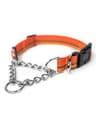
The four picks, on the specs that decide it
| Collar | Material | Hardware | Closure |
|---|
| Regal Dog Products | Vinyl-coated Biothane | Nickel-plated double buckle, metal D-ring, reinforced center ring | Buckle and hole |
| Dogline Biothane | Biothane-coated webbing, 1 in wide | Not published beyond the buckle | Quick-release |
| PWOD neoprene-lined | Nylon webbing, neoprene lining, waterproof-rated | ABS quick-release buckle | Quick-release |
| Mighty Paw martingale | Weather-proof nylon webbing | Stainless steel chain, two D-rings | Reinforced buckle, limited-slip loop |
Read the hardware column twice, because it is where waterproof collars actually fail. The webbing on all four of these will outlast the dog. A plated steel D-ring that sits wet under a tag for three summers will not — which is why Regal publishing nickel-plated metal and Mighty Paw publishing a stainless chain are worth more than any claim about the strap, and why Dogline not publishing its hardware spec is a gap rather than a detail.
The smell problem is a material problem
The reason people replace collars is almost never breakage. It is that the collar smells, and washing it only resets the clock. That smell is bacteria living in a fabric that stays damp against a warm neck, so the fix is to buy a material with nothing for them to live in. A coated collar wipes dry in seconds; neoprene is better than plain nylon but, as PWOD’s own listing concedes, will hold smell if it never dries fully.
That is the same argument the Biothane versus leather versus nylon comparison makes at length, and it applies to the leash as much as the collar — a coated long line comes out of a swamp dry, which is the single biggest quality-of-life upgrade for anyone who walks a dog near water.
Fit, and the one rule that does not change when a collar is wet
The AKC’s collar guidance gives the test everyone should use: you should be able to slide two fingers between the collar and the dog’s neck — snug enough not to pull off, loose enough not to press. Nothing about water changes that, but two things make it easier to get wrong on a coated collar.
First, coated webbing does not stretch or soften with age the way nylon does, so a collar that was slightly tight on day one is still slightly tight in year three. Fit it properly at the start. Second, buckle-and-hole sizing — the Regal’s system — adjusts in fixed steps rather than continuously, so measure the neck before ordering and pick the size whose range puts you in the middle rather than at the last hole.
A coated collar is also the easiest surface in this category to keep an ID tag legible on, which matters more than it sounds: the AKC’s identification guidance makes the point that tags fall off and wear illegible, and a collar that never softens keeps the ring and the rivet where they started. If your dog swims a lot, read the ID tag picks— a stamped steel tag survives water in a way a printed one does not.
If your dog swims, the collar is not the safety item
Worth saying on a page about water. The AKC’s water-safety guidance for dogs is about supervision, current, entry and exit points and a flotation aid for dogs out of their depth — none of which a collar contributes to. A collar that does not rot is a convenience upgrade. If your dog is going out on a boat or into open water, the actual safety purchase is a life jacket.
One genuine safety note about collars and water: anything that can snag is worse near a lake or in undergrowth, which is exactly why the Regal’s reinforced center ring exists — it is there to relieve pressure if the collar catches. For a dog that swims unsupervised in a fenced yard, a breakaway collar is the safer category, and it is not one we stock picks for.
What we would actually buy
For a dog that swims regularly, the Regal. Metal hardware, a coating you can sponge clean, a reinforced snag ring, and a listing that also rates it chew-resistant. It is priced like a mid-tier collar rather than a value one, and it is the last collar most dogs will need.
For most people, the Dogline Biothane at a third less: the same non-absorbent coated webbing with a quick-release buckle, which is faster on and off than a buckle and hole. Just note the slipperiness, and skip it if your dog is an escape artist — what to do when a dog backs out of its harness applies to collars too.
For a dog whose coat is thin or whose neck already shows a rub, the PWOD neoprene-lined collar, which costs about what plain nylon costs and puts a soft layer between the webbing edge and the skin. That edge is where collar rubs begin; collars for sensitive skin goes into it properly. Dry it after swims.
And for the swimmer that has slipped a collar before, the Mighty Paw chain martingale: weather-proof webbing, a stainless chain that will not discolor, and two D-rings so it runs as a limited-slip walking collar or a plain flat collar depending on which ring you clip. Like every martingale, it comes off between walks.