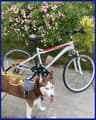
Should your dog be doing this at all?
Four checks, in order. Fail any of them and the attachment is not the purchase.
- Size and build.The AKC’s line is that only healthy, large dogs should run alongside a bike, because short legs cannot sustain bike pace. A dog that has to gallop where you are cruising is not exercising, it is being chased.
- Fully grown, and cleared by a vet. The AKC asks you to consult your veterinarian before you start, both to confirm the dog is in the right physical condition and to assess whether it can keep up. That is a short conversation at a routine appointment and it is free.
- Flat face, thick coat, or any heat sensitivity. A dog running beside a bike cannot slow you down, and heat builds faster than most riders notice. Our hot pavement guidecovers the seven-second test, and the AKC’s overheating guidance covers the signs — both are worth reading before a summer ride.
- The surface. Concrete is the problem the AKC names twice: high impact and hard on the feet. Packed dirt, gravel paths and canal towpaths are a different proposition from a sidewalk, and the same dog can do far more miles on them.
Start “very slowly with very short distances and slow speeds,” the AKC says, building up to “a block or two, and even further.” That is not a formality. The dog has no way to tell you its pads are sore until they already are.
Why an attachment and not just the leash in your hand
People do hold the leash, and it is the single worst way to do this. A lunge arrives at your handlebars, which is the one part of the bike that must not move; a dog crossing in front of the wheel takes you down; and you are steering one-handed in traffic while it happens.
An attachment fixes all three by moving the connection point from your hands to the frame. The arm holds the dog at a fixed distance to one side of the bike, clear of the wheel and the pedals, and the spring in the arm eats the energy of a sudden pull before it reaches you. That is the whole invention, and every pick here is a version of it.
It also means the clip goes to a harness, never a collar. A sideways jerk on a neck at bike speed is not something to risk; the force wants to go through a chest plate and across the dog’s body. The running harness page covers what that means in practice.
What actually separates them
Wheel clearance, which is the safety feature
The arm has to hold the line far enough from the frame that the dog cannot foul the rear wheel or the pedals. Pietenjoy describes an elevated pivot arm for exactly this, and Pawxaw uses dual 360-degree swivel clips stated to reduce wheel interference. Every pick here is designed around it. It is also the reason not to improvise with a bungee and a carabiner: the geometry is the product.
Shock absorption, which is the comfort feature
All six have it, in one of two forms: a compression spring inside the steel tube (petbetf, Pawxaw, WalkyDog) or an elastic buffer in the line itself (Pietenjoy). Malabi has both a spring and a rotating arm. You will not find a meaningful difference between them on paper, because none of these brands publishes a spring rate, and we have not invented one.
Fitment, which is where people get caught
Most of these clamp to the seat post, and seat posts vary more than the listings admit. Two picks publish a number you can measure against, and the rest do not:
| Attachment | What it needs from your bike |
|---|
| Pawxaw | Seat post 25–32 mm (1.0–1.26 in), four-bolt clamp with anti-slip bushings |
| petbetf | At least 10 in of exposed seat post; mounts either side |
| Pietenjoy | “Standard seat posts” on mountain, road, hybrid and electric bikes. No measurement given |
| WalkyDog Plus | Stated to install on virtually any bike in under five minutes. No measurement given |
| Malabi V2.0 | Bike mount with a quick-release handle. No measurement given |
| Bike Tow Leash | Rear axle, not the seat post. Its own listing asks you to check compatibility first |
If you ride a step-through, a compact frame or a full-suspension bike with very little post showing, the petbetf’s 10-inch requirement is the one that will catch you out. Measure before you order, and if your post is short, the axle-mounted Bike Tow Leash is the design that does not care.
Which side, and how high
Seat-post attachments put the load high on a thin tube. The Bike Tow Leash mounts at the rear axle instead, so the pull acts low on the frame, which is the more stable geometry and the main thing its price buys. It is also side-specific — the package here is the right-side version, so you are choosing which side your dog runs on at checkout. For US road riding that usually means the curb side, away from traffic.
What the listings do not tell you
Four of the six publish no line strength at all, and five publish no warranty period. Only one publishes an independent certification: WalkyDog Plus carries a TUV SUD Product Service approval mark, which is the single reason it is the overall pick rather than the Pietenjoy at less than half the price.
Two numbers do appear, and they should be read as brand claims rather than test results. WalkyDog states 550 lb pull strength for its 4 mm 7-strand paracord; petbetf states 1000 lb tension for its rope. Neither names a test method. They are still more than most of this category offers, which is nothing, and we have written Not published everywhere else rather than guess.
Nobody here publishes a dog weight limit. That is the spec you most want and none of them has it.
The first three rides
- Walk the bike first. Attach the dog, do not get on, and push the bike at walking pace. Most dogs need a session or two to stop treating the bike as a thing to look at.
- Then ride slower than the dog’s trot.A block, then two. The AKC’s own escalation.
- Check the pads afterwards, every time, for the first month. Concrete wears pads down before it tears them, and the dog will keep going either way.
- Carry water and finish early. A dog water bottlelives in a bottle cage, and the ride ends when the dog’s pace drops, not when your loop does.
- Know the quick release. Every pick here detaches in a second. Practice it standing still, so your hand knows where it is before you need it.
What we would actually buy
The WalkyDog Plus, and the reason is narrow: it is the only attachment on this page carrying an independent certification mark, and it publishes a line rating to go with it. For a piece of equipment that connects a running dog to a moving bicycle, a third-party approval is worth paying double the budget price for. The adjustable length and the quick-release wand are genuinely useful on top of that.
If you are not sure either of you will stick with this — and plenty of people buy one of these, use it twice and find the dog hates it — the Pietenjoy at around thirty dollars has the elevated pivot arm, the elastic buffer and the quick release, which is the whole mechanism. Find out on the cheap one and upgrade if it becomes a habit.
The petbetf is the pick if the warranty matters more than the certification; two years is four times longer than anyone else offers here, and it is budget money. The Pawxaw is the one to buy if you ride into dusk, because it is the only reflective line on the page, and it is the only attachment that tells you the seat-post diameter it fits.
Buy the Malabi only if you know your dog does not hold a steady position — a rotating arm is a real answer to a real problem, and dead weight for a dog that runs straight. And buy the Bike Tow Leash only if your seat post will not take a clamp or you specifically want the pull low on the frame. It is the best-engineered mount here and it costs more than every other pick put together, which on a value site is the review.