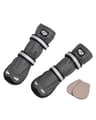
Why dog boots come off
A dog’s leg is a cone pointing the wrong way. There is no heel to hook behind and no calf to grip, so the widest part of what you are trying to hold is at the bottom and everything above it tapers. Add a gait that flexes the carpal joint through its full range at every stride and a boot held on by one strap at the narrowest point has, mechanically, almost nothing to do.
That is why the fixes are structural rather than a matter of tightening harder — and tightening harder is actively bad, because a strap cinched to compensate for a loose boot restricts circulation in a cold-weather walk. Here is what each mechanism on this page is doing about it.
| Pick | What holds it on | Sold as | Best for |
|---|
| Walkee Paws Booties & Leggings | Full-leg leggings joined over the back | Set of 4, joined | A dog that has kicked off everything else |
| MOKO PAWS Tall Outdoor | Tall shaft, top drawstring, 3 adjustable straps | Pair (buy two) | Deep snow and serial boot-shedders |
| Hipaw Extended Cuff | Extended ankle cuff, elastic drawstring, straps | Set of 4 | Medium and large dogs on salted streets |
| Ruffwear Grip Trex | Hook-and-loop ankle straps, plus a real fit | Pair (mix sizes front and rear) | Trail miles and wide front paws |
| QUMY Waterproof | Two reflective straps, wide split opening | Set of 4 | The value pick for mixed conditions |
| XSY&G Snow Booties | Two adjustable reflective straps | Set of 4 | Short salted-pavement walks on a budget |
The fix that costs nothing: buy two sizes
Most dogs have wider front paws than rear ones, because the front legs carry more of the weight. A set of four identical boots therefore fits two paws properly and two paws approximately — and the approximate pair is the pair you lose.
Ruffwear sells the Grip Trex in pairs rather than sets of four precisely so you can buy one size for the front and a smaller one for the rear. MOKO PAWS is also sold as a pair, which costs you double for four paws but gives you the same option. If you are buying a set of four, measure the front paw and accept that the rears will be roomy, then rely on the strap or cuff to take up the difference.
Measure the paw the way the brands ask: stand the dog on a sheet of paper with weight on the foot, mark either side of the splayed paw, and measure the width across. A paw measured in the air is narrower than a paw that is bearing weight, and that single mistake accounts for a lot of lost boots.
What a boot is actually protecting against
Retention matters because the protection is real. In summer the hazard is surface temperature — pavement sits far hotter than the air above it, and the AKC’s own guidance is to keep a dog off hot asphalt and test it with the back of your hand before you walk. Our hot pavement guide covers the timing and the five-second test.
In winter the hazards are ice-melt chemicals and packed snow between the toes, and the AKC and AVMA both flag paw care and chemical exposure as the cold-weather issues owners underestimate. A boot that stays on for a whole salted walk is the simplest answer to both. Our winter dog boot picks rank the same category on insulation and cuff height instead of retention, and how cold is too cold is the decision about whether to go out at all.
Getting a dog to accept boots
A dog that hates boots takes them off, so acclimation is part of retention. The sequence that works is boring and short: one boot, in the house, for a minute, with a treat, then off. Four boots indoors on a carpet before anything outdoors. Then one short walk, not the hour-long trail day you bought them for.
Expect the high-stepping walk for the first week — it is proprioception, not pain, and it passes. What does not pass is a boot that is too tight or a strap done up over a fold of skin, so check the fit after the first ten minutes every time until you trust it. If your dog is a confirmed boot-remover, go straight to the legging design and skip the arms race.
What we would actually buy
A dog that has already lost boots: the Walkee Paws leggings. It is the only design on this page where losing one is not physically possible on a walk.
A conventional boot that holds: the MOKO PAWS tall boot for snow, or the Hipaw extended cuff for medium and large dogs on salted streets. Note the Hipaw listing says plainly that it is not for small breeds.
Trail miles: the Grip Trex, bought as two pairs in two sizes. The Vibram outsole is the grip answer and the mixed sizing is the retention answer.
On a budget:the QUMY set of four. On the tightest budget, the XSY&G — four boots for less than one premium pair, with no cuff and no insulation, which is a defensible trade for a twenty-minute walk and a poor one for a hike.