The four things that separate a winter boot from a summer bootie
Most “snow boots” on the market are the same neoprene-and-rubber bootie sold for hot pavement, with a different photograph. Four specifications actually change in winter, and you can check all four on a listing before you spend anything.
1. A seal at the top
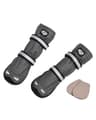
This is the one that matters most and the one buyers think about least. A short bootie with an open cuff lets snow pack in around the ankle, where it melts against the leg and then refreezes. A boot with an extended cuff, a drawstring or a zippered gaiter keeps the snow outside the boot. On this page the Hipaw uses an extended cuff with an elastic drawstring, the MOKO PAWS uses a tall shaft with a drawstring at the top, and the Ruffwear uses a stretch gaiter with a zip. The two cheapest boots here have neither, which is exactly why they are the two cheapest boots here.
2. A sole compound rated for ice
Almost every listing says “anti-slip.” Almost none says what the rubber is or what it was designed to grip. Ice is a specific problem: rubber that grips rock and asphalt can be hard and glassy at freezing temperatures. The Ruffwear is the only boot here naming its outsole — Vibram Icetrek, with a winter-specific lug pattern — and the MOKO PAWS is the only other one that specifies its material at all, as a deep-tread natural rubber. On the rest, “anti-slip sole” is the whole disclosure, so we have written the spec row as exactly that rather than dressing it up.
3. Insulation is not the same as waterproofing
This is the biggest honest gap in the category. A waterproof boot keeps water out. An insulated boot keeps heat in. They are completely different claims and most winter boots only make the first one. Of the six here, exactly one — the Ruffwear Polar Trex — publishes an insulated softshell upper. The Hipaw publishes a fleece lining, which is warmth but is not the same engineered claim. The budget picks publish neither, and their spec rows say so.
Whether that matters depends on your dog and your walk. The AVMA lists coat type, body fat, activity level and overall health as the four variables that set an individual dog’s cold tolerance, and notes that short-haired and short-legged dogs get cold fastest. A husky on a twenty-minute walk does not need insulated feet. A whippet standing still in a park at 15°F might.
4. Whether it stays on
The universal failure mode. A boot in a snowbank protects nothing and you will not find it until spring. Retention comes down to strap count and boot shape: the MOKO PAWS uses three adjustable straps and explicitly names boots slipping off as the problem it is solving, the Ruffwear and Hipaw use two plus a cuff closure, and the budget pair use two straps. If your dog has already defeated two sets of boots, the leggings at the bottom of this list are a different approach entirely — the boot is attached to a legging, so it physically cannot be kicked away.
The pairs-versus-sets pricing trap
Read the quantity before you read the price. Ruffwear and MOKO PAWS both sell in pairs of two boots, not sets of four, and both explain why: dogs often have wider front paws than rear paws, so buying two packs lets you mix widths for a genuinely better fit. That is a real benefit, and it also means the sticker price is half the price of booting a dog. The Hipaw, QUMY and XSY&G listings include four boots. Once you double the pair prices, the gap between the premium and budget ends of this page is wider than it first looks, which is worth knowing before you decide the expensive one is only somewhat more expensive.
Sizing, in winter specifically
Boots are sized on paw width, not on your dog’s weight, and every listing that gives you a weight range is offering a rough proxy. Stand the dog up so the paw is bearing weight and spreading naturally, then measure across the widest point. QUMY publishes a full inch-by-inch chart across eight sizes; XSY&G states plainly that its chart is measured by hand and to allow for a little error, which is a more honest disclosure than most and also a reason to measure carefully.
Two winter-specific notes. First, a boot that fits perfectly over a bare paw can be tight over a foot with fur that has not been trimmed between the pads, and untrimmed fur is also what ice balls form in. Second, do not size up hoping for an easier fit — a loose boot rotates, the sole ends up on the side of the paw, and it comes off. Snug is what stays on.
The free alternative, which works for most dogs
We would rather sell you nothing than sell you the wrong thing, so: if your dog’s winter is short walks on salted pavement, washing the paws when you get home is the AKC’s own recommendation and it costs nothing. A bowl of warm water and a towel inside the door removes the de-icer and the grit, and it gives you thirty seconds to check for cracks, cuts and ice packed between the toes. Plenty of dogs never need boots at all.
Boots earn their place when one of four things is true: the walk is long enough that repeated salt exposure adds up, your dog already has cracked or sore pads, you are on genuine ice where traction matters for the dog’s footing, or your dog is one of the short-coated and short-legged types the AVMA flags as losing heat fastest. If none of those describes your dog, buy the towel.
Getting a dog to accept boots
Every dog does the same high-stepping puppet walk the first time, and most owners conclude the boots do not fit. Usually they just feel strange. Put them on indoors for two minutes with something good happening, take them off before the dog gets fed up, and repeat. Build up to a short walk before you rely on them for a cold one. Do not let the first experience of boots be a mile in sleet, and do not fasten them so tight that the straps mark the leg — snug enough not to rotate is the standard, not tourniquet-tight.
What boots do not do
They protect the paws and nothing else. They are not a substitute for a coat on a dog that needs one, they do not extend how long a dog can safely be outside, and they do not change the cold-tolerance variables the AVMA lists. The AKC’s hypothermia bands are measured in core body temperature, not paw temperature, and a booted dog can still get too cold. If it is cold enough that you are thinking about boots, it is worth reading how cold is too cold for the temperature guidance itself, and considering whether a winter coat is the more useful purchase for your particular dog.