Collar Creek

Will a collar stop your dog barking?

No — and this is one of the few questions in dog gear with a published, unambiguous answer. The AKC’s own position is that an anti-bark collar treats the symptom and does nothing about the problem. Here is why, and what the money is better spent on.

By Stephen V.Updated How we research

How this is funded: we earn a commission if you buy through our links, at no extra cost to you. It never changes which product we recommend, and we’ll tell you when we’d skip one. Full disclosure.

Most questions in this category come down to a judgement call. This one does not. The American Kennel Club’s own article on bark collars says that getting an anti-bark collar “will treat the symptom for immediate relief but will do nothing to fix the problem in the long run”, and that “behavior modification is the only way to address this problem”. That is the organization’s published position, not an inference from it.

We are an affiliate site. We would make money if we sold you a bark collar, and we do not stock one. This page exists to explain why, and to be useful about the thing you actually came here to solve.

Why the device cannot work, mechanically

An automatic bark collar triggers on a sound. That is the whole of its logic, and it is the whole of the problem, because barking is not one behavior. It is at least five, with five different causes:

  • Alert barking— something moved outside. The dog is doing the job it was bred for.
  • Demand barking— barking has previously produced a ball, a door opening, or your attention. It is working.
  • Boredom barking— nothing has happened for six hours and the dog is making its own entertainment.
  • Frustration barking— the dog can see something it cannot get to. A window and a fence are the two classic sources.
  • Distress barking— the dog is alone and not coping. This is the serious one and it is covered below.

A collar that fires on sound treats all five identically, and none of the five is caused by a lack of consequences for making noise. Suppress the noise and the cause is still sitting there: the bored dog is still bored, the frustrated dog is still at the window, the frightened dog is still frightened and now has something else to be frightened of.

The AKC’s rundown of bark-control devices adds a failure mode most owners never consider until it happens: “if you have multiple dogs and only one dog is a nuisance barker, take note that all the dogs will receive the device’s correction”. In a two-dog house, the quiet dog gets punished for the loud one. Its practical advice, repeated twice in the same article, is to consult a professional trainer — both to start positive-reinforcement training and for advice on these devices and your individual dog.

What to look for instead: diagnose, then change the setup

Before any purchase, spend two days noting when the barking happens and what was happening immediately before. That log is worth more than any product on this page, because it tells you which of three cheap interventions applies.

  • Change what the dog can see or hear. This is the highest-value fix and it is usually free or close to it. A dog that barks forty times a day at people passing a window is rehearsing forty times a day. Frosted film on the lower half of the glass, moving the furniture it patrols from, or shutting that room in the busy hours takes the number to zero, and a behavior that is not rehearsed fades.
  • Pay the alternative.The AKC’s marker-training guidance is the method: the marker “must mark the correct moment and every click must be followed by a reward”. Applied here, that means the instant the dog looks at you instead of the trigger, mark and pay. You cannot do this unless the food is already on your body — which is the one piece of equipment this page does recommend.
  • Make the reward worth turning around for.The AKC’s treat guidance is specific: soft treats beat crunchy ones because they are faster to eat, a pea-sized piece is plenty even for a large dog, and smelly high-value items outrank kibble in a distracting situation. It also has a ceiling — the 10% rule is about calories, not treat count — which is why pouch capacity matters less than you would think.

One thing worth saying about the collar the dog is already wearing: it has no part in this. A flat collar carries ID and gives you somewhere to clip a leash, and the everyday collar picksare judged on exactly that rather than on any behavioral claim. Nothing you buckle round a dog’s neck changes why it barks.

Three things decide whether a treat pouch is any use for this: one-handed opening, because you have a leash or a door in the other hand; a closure that does not spill when you move fast; and a material that does not hold the grease from soft treats. Capacity is almost irrelevant — a cup is already more than most dogs’ daily allowance.

Three things from our registry that address the actual causes. Two are treat pouches, because every method above assumes the reward is already on your hip; one is a crate cover, for the specific and very common case of a dog barking at movement it can see from the crate. There is no collar in this list, which is the point of the page.

Quick picks

Ranked on specs, value and fit. Select a row to jump to the full write-up. We have not tested these ourselves — here is exactly what we do instead.

#ProductBest forPrice
1
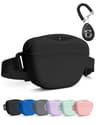
heouvo Magnetic Silicone Treat Pouch with Clicker, 1.67 Cup

heouvo Magnetic Silicone Treat Pouch with Clicker, 1.67 Cup

Everything the job needs and almost nothing it does not: food-grade silicone so treat oil has nothing to soak into, two magnets you can open with one hand, 1.67 cups in a body the size of a deck of cards, and a real waist belt instead of a plastic clip. The clicker is in the box. It is also the cheapest pouch we would recommend.

Best overall: pouch and clicker in one box
$9.99 · View on Amazon

Price as of October 10, 2026. #ad How we’re funded

2
Mighty Paw Treat Pouch 2.0, No-Spill Magnetic Clasp

Mighty Paw Treat Pouch 2.0, No-Spill Magnetic Clasp

The one that replaces the whole walking kit. Four compartments and a stated 2-cup treat capacity, a poop bag dispenser built into the side with a roll included, and a 30-52 in sling so it wears cross-body instead of pulling on your waistband. It is also the heaviest fabric pouch here, and its listing says nothing about washing it.

Best for walking two dogs
$19.99 · View on Amazon

Price as of October 10, 2026. #ad How we’re funded

3
Explore Land Breathable Dog Crate Cover, 36 in

Explore Land Breathable Dog Crate Cover, 36 in

Mesh on all four sides, so the crate gets the privacy of a cover without the still air of one. Explore Land itself calls it a basic cover for basic use, which is the most honest sentence in this category, and at this price it is the right cover for a warm room.

Best for crate barking at movement
$17.99 · View on Amazon

Price as of October 10, 2026. #ad How we’re funded

#1Best overall: pouch and clicker in one box

heouvo Magnetic Silicone Treat Pouch with Clicker, 1.67 Cup

Everything the job needs and almost nothing it does not: food-grade silicone so treat oil has nothing to soak into, two magnets you can open with one hand, 1.67 cups in a body the size of a deck of cards, and a real waist belt instead of a plastic clip. The clicker is in the box. It is also the cheapest pouch we would recommend.

Strengths

  • 1.67 cups stated, in a body the listing measures at 5 x 4 x 2 in - small enough to forget you are wearing, and already more treat than a 10% daily allowance for most dogs
  • Food-grade silicone rather than lined fabric, stated bisphenol-free and rated for wet or frozen food as well as dry, so the grease from soft high-value treats has nothing to soak into
  • Waist belt adjustable 25-47 in, which the listing says was added specifically because plastic belt clips break or fall off mid-walk; a training clicker is included

Trade-offs

  • The narrow mouth is a deliberate anti-spill choice and it is a real trade - fewer spills, a slower grab than the wide-mouth pouches below
  • States no dishwasher or machine-wash instruction, only that the silicone bends and flips for cleaning, so we have written its washing spec as not published
  • No outer pocket at all - phone, keys and poop bags live somewhere else
Capacity1.67 cups, stated for dry, wet or frozen food
MaterialFood-grade silicone, stated bisphenol-free
ClosureTwo built-in magnets; one-handed, deliberately narrow mouth
CarryAdjustable waist belt, 25-47 in
Size / weightApprox. 5" L x 4" W x 2" H; 0.31 lb
Clicker includedYes
WashingNot published
Warranty12 months, stated

Specs read from the product listing on October 4, 2026. “Not published” means the brand does not state that figure.

#2Best for walking two dogs

Mighty Paw Treat Pouch 2.0, No-Spill Magnetic Clasp

The one that replaces the whole walking kit. Four compartments and a stated 2-cup treat capacity, a poop bag dispenser built into the side with a roll included, and a 30-52 in sling so it wears cross-body instead of pulling on your waistband. It is also the heaviest fabric pouch here, and its listing says nothing about washing it.

Strengths

  • Stated 2 cups of treats across four compartments in a 7" x 2.5" x 5" body, with room for a phone, wallet or keys
  • Belt sling adjustable 30-52" plus a metal clip, so it can be worn over the shoulder, cross-body, on the waist or on a belt - the most adjustable carry here
  • A poop bag dispenser is built into the side and a roll of bags is included, which is one fewer thing in your hand

Trade-offs

  • Heaviest fabric pouch on the page at a listed 0.55 lb, which you notice cross-body on a long walk
  • The listing states no fabric and no washing instruction at all, so two spec rows read not published
  • 2 cups is well past most dogs' daily treat allowance, and the extra compartments are bulk you carry whether you fill them or not
CapacityUp to 2 cups across four compartments, stated
MaterialNot published
ClosureTwo magnets, stated no-spill
CarryBelt sling adjustable 30-52" plus a metal clip; shoulder, cross-body, waist or belt
Size / weightApprox. 7" x 2.5" x 5"; 0.55 lb
ExtrasBuilt-in poop bag dispenser; a roll of bags included
WashingNot published
Clicker includedNo

Specs read from the product listing on October 4, 2026. “Not published” means the brand does not state that figure.

#3Best for crate barking at movement

Explore Land Breathable Dog Crate Cover, 36 in

Mesh on all four sides, so the crate gets the privacy of a cover without the still air of one. Explore Land itself calls it a basic cover for basic use, which is the most honest sentence in this category, and at this price it is the right cover for a warm room.

Strengths

  • Large mesh panels on four sides - continuous airflow, stated on the listing, with the dog still able to see out
  • Explore Land describes it plainly as a basic cover offering basic light blocking and good ventilation - no over-claiming
  • Drapes over and sticks with hook-and-loop on four sides; fits 1-, 2- and 3-door 36 in crates

Trade-offs

  • Mesh means it blocks less light than a solid cover - if your dog needs dark, not just calm, this is the wrong pick
  • Fabric is described only as "light synthetic material"; no denier, no wash instruction
  • Lighter and looser than a fitted cover, so a dog that paws at the sides can pull it through the bars
FitsMost 36 in wire crates, 1-, 2- and 3-door
Cover size36" L x 23" W x 25" H
MaterialLight synthetic fabric with mesh panels on 4 sides
WashingNot published
FasteningHook-and-loop, four sides
Weight0.7 lb

Specs read from the product listing on September 20, 2026. “Not published” means the brand does not state that figure.

If the barking happens when you leave

This is the case where buying a collar does real harm, and it is worth separating out clearly. A dog that barks, howls, paces, destroys doorframes or soils the house specifically when it is left alone may have separation anxiety, which the ASPCA describes as a distress response to being left rather than a disobedience problem. Its guidance is explicit that escape attempts by affected dogs “are often extreme and can result in self-injury” — broken teeth, cut and scraped front paws, damaged nails — and that you should not scold or punish the dog, because “anxious behaviors are not the result of disobedience or spite”.

A device that punishes the noise an anxious dog makes while it is already distressed adds a second aversive event to a situation the dog cannot escape. What addresses it is a graduated plan, usually with a veterinarian or a qualified behaviorist, and sometimes medication alongside the training. The ASPCA also notes that a crate helps some dogs and raises stress in others, and that where a dog shows heavy panting, salivation, frantic escape attempts or persistent howling, “crate confinement isn’t the best option for him” — a room behind a baby gate is offered instead.

If that description fits your dog, the hundred dollars is better spent on one session with a behaviorist than on any hardware, and the page on crying in the crate at night covers the overlap with crate problems.

The one thing a product does fix

Crate barking at movement is the exception, and it is genuinely a visibility problem rather than a behavior problem. The AKC notes that some dogs prefer a wire crate so they can see the world around them while others settle better in a darker, more den-like crate — such as one with a removable cover. If your dog barks from the crate every time someone walks past the hall, a cover removes the trigger rather than punishing the response.

Two cautions, both from published guidance rather than invented. Airflow first: a cover that cuts ventilation is a heat problem, which is why the mesh-sided pick above is the one we would buy for a warm room. And introduce it gradually — the manufacturer guidance on covers is to add the ceiling panel first, then the sides, and never to cover a crate as a punishment. Our crate cover page ranks the full set on exactly those terms.

What we would do

Spend two days writing down when the barking happens. Then change the environment that produces it — the window, the room, the hour — before you buy anything at all, because that step alone resolves a large share of household barking and it is free.

Then buy a treat pouch and wear it. Not because a pouch stops barking, but because every method that does stop barking requires you to pay the dog within half a second of it making the right choice, and nobody does that reliably when the food is in a cupboard in the kitchen. The treat pouch picks cover the rest of the field.

And if what you want is a cue your dog can feel at distance — a recall for a deaf dog, or a tap on the shoulder in a field — that is a real use for a remote trainer’s vibration mode, and it is a completely different purchase from an automatic bark collar. The vibration versus shock comparison is where that decision lives.
General guidance, not professional advice. Collar Creek is written by a dog-gear enthusiast, not a vet or a certified trainer. For behavior problems, an injury, or a medical question, talk to a professional. Always check fit, and supervise any new gear at first.

Frequently asked questions

Will a bark collar stop my dog barking?

It may suppress the sound for a while. It will not fix the barking, and the AKC says so directly: an anti-bark collar 'will treat the symptom for immediate relief but will do nothing to fix the problem in the long run', and 'behavior modification is the only way to address this problem'. A dog that barks because it is bored, frightened or alerting still has that reason after the collar goes on.

Do we stock a bark collar?

No. There is no automatic bark collar in our product registry, and that is deliberate rather than an oversight - we would not be able to write an honest case for one. The remote trainers we do list are owner-operated tools for teaching cues at distance, not automatic devices that fire when a dog makes a noise, and we cover them on the training collar page.

What is wrong with an automatic bark collar specifically?

It fires on a sound rather than on a behavior, so it cannot distinguish a bored bark from an alarm bark from a dog barking at an intruder. The AKC also names a failure mode owners rarely consider: 'if you have multiple dogs and only one dog is a nuisance barker, take note that all the dogs will receive the device's correction'. And because the device punishes rather than teaches, the dog is given no alternative behavior.

What actually stops a dog barking?

Working out what the barking is for, then removing the trigger or paying the dog for the behavior you want instead. Alert barking at a window is usually solved by changing what the dog can see. Demand barking is solved by not paying it. Boredom barking is solved by exercise and something to chew. Barking when left alone may be separation anxiety, which the ASPCA describes as a distress response needing a graduated plan and often professional help.

Is a citronella spray collar better than a static one?

It is a different unpleasantness, not a different approach. The AKC's rundown of bark-control devices describes spray collars as 'emitting a spurt of air or citronella when they detect a bark', alongside vibration collars, and names static correction as one of the other methods. All of them share the same two problems: they fire on sound rather than on cause, and they tell the dog nothing about what to do instead.

How do I stop my dog barking at people outside the window?

Change the view before you change the dog. Frosted film on the lower half of the window, moving the sofa the dog patrols from, or closing that room during the hours the street is busy will cut the number of rehearsals a day from forty to zero. Then teach a different response to the trigger that remains: the AKC's marker-training guidance is the method - mark and pay the dog the instant it looks at you rather than at the window.

Can a crate cover help with barking?

For a dog that barks at movement it can see from the crate, yes, and it is the cheapest fix on this page. The AKC notes that some dogs settle better in a darker, more den-like crate, such as one with a removable cover. Introduce it gradually and never use a covered crate as punishment. It does nothing for a dog that barks because it is alone - that is a separation problem, not a visibility one.

Sources

  • American Kennel Club — Control Dog Barking: Why Bark Collars Don't Work — AKC: getting an 'anti-bark' collar "will treat the symptom for immediate relief but will do nothing to fix the problem in the long run. Behavior modification is the only way to address this problem." (accessed October 11, 2026)
  • American Kennel Club — Bark Control Tools to Help Stop Nuisance Barking — AKC on automatic bark-control devices: "if you have multiple dogs and only one dog is a nuisance barker, take note that all the dogs will receive the device's correction"; the device types it describes are vibration collars and spray collars "emitting a spurt of air or citronella when they detect a bark", with static correction named only in passing as one of the "other kinds of bark control methods"; it repeatedly directs owners to professional help - "Consult with a professional trainer for to get started with positive reinforcement training" and "Consult with a professional trainer for advice on these devices and your individual dog." (accessed October 11, 2026)
  • American Kennel Club — Clicker Training: Mark & Reward Dog Training Using Clickers — AKC on marker timing: the click marks the exact moment the dog did the right thing and bridges the gap until the reward arrives; 'The click must mark the correct moment and every click must be followed by a reward'; praise can be used the same way but 'it's not nearly as clear' (accessed October 4, 2026)
  • American Kennel Club — The Right Treats Make the Best Rewards: How to Choose — AKC: 'Even for large dogs, a pea-sized treat is plenty. For small dogs, you can use even tinier pieces'; soft treats beat crunchy ones because they are 'easier and faster for your dog to eat' and biscuits lose time to crumbs on the floor; most dogs rank smelly items like cheese or bacon at the top of the reward hierarchy while kibble fails in a distracting location; 'having food in your pocket or a dog treat pouch at all times will allow you to provide an immediate reward' (accessed October 4, 2026)
  • ASPCA — Separation Anxiety — ASPCA: 'Escape attempts by dogs with separation anxiety are often extreme and can result in self-injury and household destruction, especially around exit points like windows and doors', with broken teeth, cut and scraped front paws and damaged nails named as the injuries; 'Crate training can be helpful for some dogs if they learn that the crate is their safe place to go when left alone. However, for other dogs, the crate can cause added stress and anxiety'; where the dog shows heavy panting, excessive salivation, frantic escape attempts or persistent howling, 'crate confinement isn't the best option for him', and confining the dog to one room behind a baby gate is offered instead; 'Do not scold or punish your dog. Anxious behaviors are not the result of disobedience or spite.' (accessed October 4, 2026)
  • American Kennel Club — Everything You Need to Know About Crate Training Your Dog — AKC: some dogs prefer a wire crate so they can see the world around them, while others settle better in a darker, more den-like crate, such as one with a removable cover; never use the crate for punishment; caution on soft bedding a puppy may soil or shred (accessed September 20, 2026)

Keep reading